
AI Root Cause Analysis vs Traditional Troubleshooting

An incident tool can name a plausible cause without giving an engineer enough information to act. A deployment appears beside an error spike, a dependency turns red, and a generated summary recommends rollback. The explanation sounds coherent. Yet the deployment may be unrelated, the dependency may be a downstream symptom, and rollback may create another problem. For enterprise buyers, the useful comparison is how each investigation method reaches a defensible conclusion and records what remains uncertain.
How the two approaches differ
AI root cause analysis helps assemble operational evidence and propose explanations. Traditional troubleshooting relies on engineers selecting observations and tests. Both require causal verification, explicit uncertainty, and authorized remediation. Buyers should compare supported conclusions and decision records, not presentation quality.
Traditional troubleshooting is not limited to people reading dashboards. Teams already use queries, scripts, tracing, dependency views, and established playbooks. An AI-assisted approach may add automated retrieval, statistical relationships, model-generated hypotheses, or conversational access. Those mechanisms have different strengths and failure modes. Ask which mechanism supports a specific conclusion instead of treating the phrase AI RCA as a single technical capability.
The business consequence matters before the feature comparison. An investigation can affect service restoration, data reconciliation, change approval, and communication with business owners. A wrong recommendation can consume the same people needed for recovery. A useful evaluation therefore includes the cost of reviewing the output, correcting it, and handing the record to another engineer, not simply the time until a sentence appears.
What remains valuable in traditional troubleshooting
Engineers contribute knowledge that may not exist in telemetry: a migration in progress, an undocumented dependency, a known customer exception, or the reason a change was approved. They can challenge the scope of an observation and design a test that distinguishes competing explanations. Google's Effective Troubleshooting chapter describes an iterative process of proposing and testing causes, including evidence that contradicts a theory. That discipline remains necessary when software proposes the theory.
Manual investigation also has practical limits. Queries depend on what the responder knows to ask, evidence can be scattered, and an incomplete handover can cause repeated work. These are conditions to measure in your environment, not proof that every manual process is slow or every AI system is better. A well-maintained playbook for a familiar failure may be the most appropriate response. Preserve it as a serious evaluation baseline.
Where AI assistance can change the work
A candidate system might collect related observations, identify an affected path, and propose the next question. Evaluate those functions separately. Retrieval should return the right records. Correlation should group relevant observations without hiding exceptions. A generated explanation should distinguish observations from interpretation. Suggested action should identify its assumptions and required authority. Performing well in one area does not necessarily mean the system will deliver equally dependable results across other functions.
ClairAI's intelligent alerting article discusses cross-signal context and dependency awareness. In a buying evaluation, the next step is to inspect the actual evidence behind a proposed relationship. OpenTelemetry distinguishes metrics, logs, and traces; those signals answer different questions. A trace can locate an observed request path, while an error record can describe a failed operation. Neither provides conclusive evidence of the failure’s origin or confirms that every impacted request was captured.
| Investigation task | Traditional approach | Assisted approach and acceptance test |
|---|---|---|
| Gather observations | Engineer chooses queries and records | Inspect retrieved records and omissions |
| Propose a cause | Engineer develops a testable explanation | Inspect source links and alternative explanations |
| Test the cause | Engineer compares or tests system behavior | Verify that proposed tests distinguish causes |
| Choose remediation | Authorized owner assesses action risk | Retain approval and recovery checks |
Apply the same evidence standard to both methods
Start with a bounded claim. Name the affected operation, environment, observation window, and proposed failure mechanism. Ask for original records or traceable links, not only a rewritten summary. Preserve event time separately from ingestion time where the distinction matters. When a system cites a change, check that the change actually reached the affected component before the symptom. A nearby timestamp alone is weak evidence.
Next, ask what would make the explanation wrong. Compare an affected path with a relevant unaffected path, inspect alternative dependencies, and identify missing observations. Prefer non-disruptive checks before production experiments. A test that changes several settings at once may restore service while leaving the causal explanation unresolved. Record that distinction instead of upgrading a useful mitigation into a proven diagnosis.
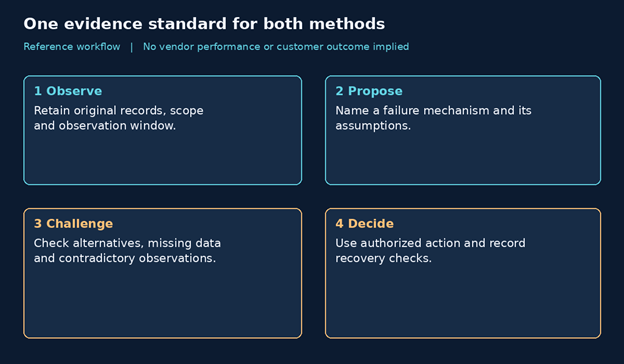
A hypothetical comparison using one failed pipeline
Consider an illustrative reporting pipeline that finishes late after a connector configuration change. This is not a ClairAI customer incident or a measured benchmark. In the manual path, an engineer reviews the late report, checks the workflow history, and compares source response errors with the deployed configuration. In the assisted path, a candidate system assembles those same records and proposes that a changed source endpoint caused repeated retries.
Both paths must establish the same facts. The changed configuration must belong to the affected execution. The error must match the proposed mechanism. A relevant unchanged execution should provide a meaningful comparison, and the engineer must check whether another upstream delay better explains the result. If the candidate system merely groups the late report with every change from that morning, it has supplied a search starting point rather than a supported cause.
Suppose a configuration comparison confirms an incorrect endpoint for that connector, while the source remains reachable through the approved endpoint. That supports a narrower explanation than a general source outage. An authorized owner can consider restoring the configuration under the team's change procedure. The investigation still needs a subsequent execution check and reconciliation of delayed reporting. No resolution time, savings, or product performance follows from this hypothetical sequence.
Keep remediation and escalation under operational control
Before remediation, establish the proposed action, affected resources, approver, stop condition, and verification method. Check whether retrying creates duplicate records or whether rollback changes data compatibility. The relevant question is whether the evidence supports this action for this workload. A recommendation expressed confidently is not a permission grant, and access to read telemetry should not automatically confer permission to change production.
Escalate when impact or uncertainty exceeds the current team's authority, when data integrity is in question, or when the proposed intervention crosses an ownership boundary. Google's incident-response workbook emphasizes clear roles and a working record of debugging and mitigation. Use that record to explain what has been observed, which theories were rejected, and what decision another team needs to make. Do not wait for a complete causal narrative when urgent containment requires a responsible decision maker.
Limits that a demonstration should make visible
Incomplete instrumentation limits both methods. Missing collectors, sampled traces, inconsistent identifiers, clock differences, and outdated dependency information can make a relationship appear stronger than it is. An AI explanation should state its coverage and unresolved questions. A missing record must not silently become evidence that an event did not occur. Test whether the system can acknowledge that the available data supports several explanations or no defensible explanation.
Historical incidents create another evaluation risk. A familiar-looking failure may have a different cause, and a past fix may no longer be appropriate. Keep investigation examples separate from the material used to configure the evaluation. Include an incident whose correct conclusion is insufficient evidence. Google's postmortem guidance also supports broader participant review and accountable follow-up; a generated summary should help that review rather than replace it.
Build a comparison that buyers can audit
Select representative incidents with reviewed evidence, then give both methods comparable access and scope. Define what counts as a supported conclusion before running the exercise. Record retrieval omissions, incorrect causal claims, useful next tests, and the review effort needed to accept or reject the output. Evaluate an unfamiliar case as well as a familiar one. Do not compare a fully instrumented assisted scenario with a manual scenario deliberately deprived of relevant records.
Retain the complete evaluation record, including unsuccessful attempts. Separate time to first hypothesis from time to a supported explanation, time to authorized mitigation, and verified restoration. State whether human review is included. If an evaluator supplies missing context, record that intervention. The resulting comparison should show which tasks changed, who still performed them, and where the candidate system required correction. A single persuasive demonstration cannot establish a general production outcome.
Inspect the access model as part of the same exercise. A demonstration using unrestricted administrator credentials may reveal observations that a production responder cannot retrieve. Test the intended user role and document where another owner must grant access or supply evidence. If the system proposes a cross-team relationship, check that the receiving team can inspect its basis without exposing unrelated customer or operational data. A conclusion that cannot be reviewed under the intended permissions may be difficult to use during a real incident.
Finally, agree how uncertainty will be communicated. A confidence label is not enough unless its meaning and evaluation basis are explained. Ask the candidate system to distinguish a directly observed fact, a supported interpretation, and an unresolved possibility. Review whether new contradictory evidence changes the explanation and preserves the earlier reasoning. This gives the buyer a concrete test of revisability rather than rewarding a fluent answer that remains unchanged after its premise has been disproved.
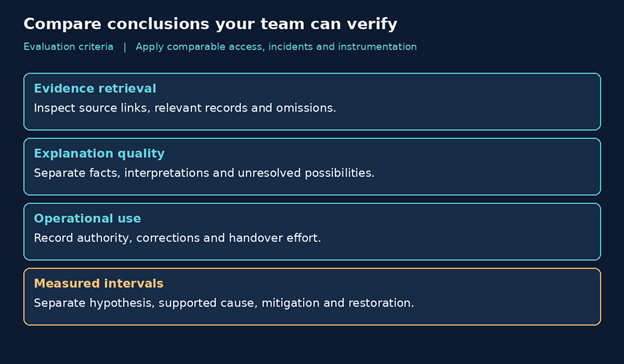
A source-grounded decision rule
Use Google's troubleshooting method as the standard for testing explanations, OpenTelemetry's signal definitions to identify the observations available, and incident-response roles to govern action. Add AI assistance where it produces traceable evidence or useful tests that your team can verify. Retain manual investigation when access is incomplete or the proposed explanation cannot survive scrutiny. This is an editorial evaluation framework, not a vendor certification or benchmark result.
Make the next demonstration evidence led
ClairAI publicly describes natural-language investigation, cross-system correlation, and guided remediation. Assess those descriptions against your representative workload, required evidence, and operating authority. Request an AI RCA demo through the ClairAI homepage bringing an anonymized incident and the questions an engineer would need answered before acting. A useful demonstration should leave your team able to explain the conclusion, challenge its limits, and continue the investigation without relying on an unsupported assertion.
Frequently asked questions
Does AI root cause analysis replace an engineer's judgment?
No. Engineers still assess evidence, risk, and authority. Evaluate which tasks the system performs and which conclusions require human validation before remediation.
How is alert grouping different from identifying a cause?
Grouping associates observations. A causal explanation must describe a plausible failure mechanism and survive relevant tests, including evidence that could contradict it.
What should a buyer request before accepting a remediation recommendation?
Request source observations, affected scope, assumptions, alternative explanations, action authority, stop conditions, and recovery checks. Match the evidence to the proposed intervention.
How should a proof of concept compare investigation time?
Separate first hypothesis, supported explanation, authorized mitigation, and verified restoration. Include human review and corrections, using comparable incidents, access, and instrumentation.
When should a team escalate rather than keep investigating?
Escalate when impact, uncertainty, data integrity concerns, or proposed actions exceed current authority. Pass the evidence record and the specific decision required.
See ClairAI in action
Turn enterprise data chaos into confident, real-time decisions.
Schedule a Demo →