
Automated Root Cause Analysis: How Enterprise Teams Trace Incidents
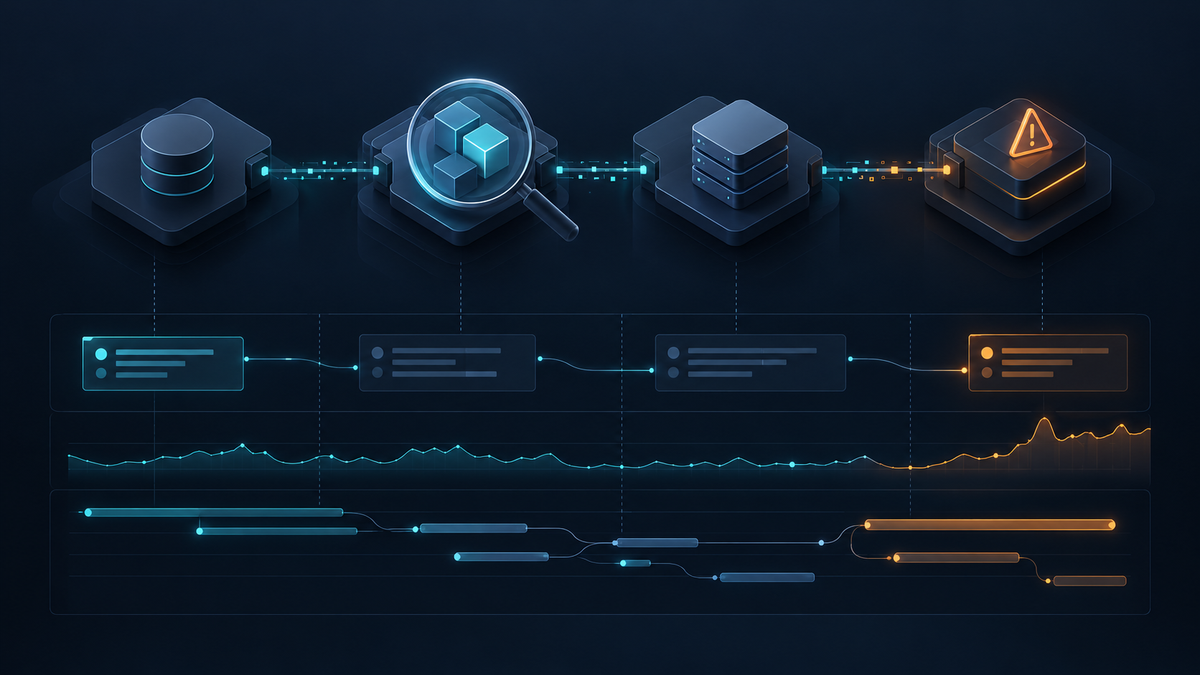
Automated root cause analysis uses software to collect incident evidence, reconstruct timelines and dependencies, and test explanations for a failure. It helps engineers distinguish symptoms from likely causes while keeping people accountable for production decisions and clearly identifying unresolved questions.
A finance report misses its refresh deadline. The transformation job has failed, the orchestrator shows retries, and several dashboards report stale data. Each signal describes a problem, but none establishes where the failure began. Restarting the visible job might consume more resources while leaving the upstream fault untouched. Enterprise teams need an investigation that explains the chain.
The practical value of automation is its ability to assemble relevant records consistently and give responders a better starting point. A useful workflow preserves the evidence behind a diagnosis, considers competing explanations, and identifies what remains unknown. For technology leaders, the buying question is whether that process improves investigation quality without hiding operational risk behind a confident answer.
Separate the symptom, the correlation, and the causal explanation
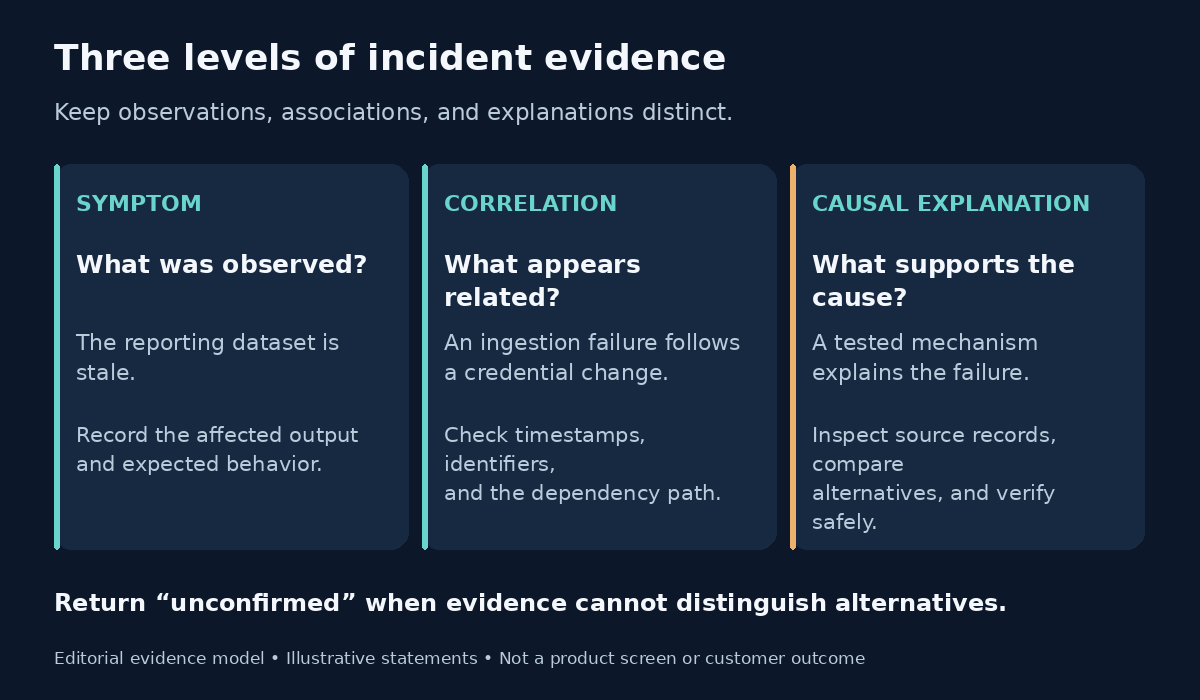
A symptom is an observed departure from expected behavior: a failed request, delayed dataset, or elevated error rate. Correlation means that signals appear related through timing, shared resources, or dependency information. A causal explanation describes a mechanism that could produce the observed failure and is supported by tests or other distinguishing evidence. Those are different levels of knowledge.
For example, a deployment and a database latency spike may occur together without the deployment causing the latency. A shared infrastructure issue could affect both. Google's Effective Troubleshooting guidance warns against treating correlation as causation and describes testing hypotheses against observations. An automated investigation should expose alternative explanations rather than collapse the first plausible association into a confirmed cause.
Alert grouping still has a useful role. It helps responders see related notifications together and choose where to investigate. ClairAI's discussion of intelligent alerting covers that earlier stage. Root cause analysis then asks whether the grouped evidence supports a specific failure mechanism, which affected components it explains, and what observation would disprove the proposed explanation.
Start with evidence that responders can trace
Define the incident boundary
Record the affected business service, expected behavior, actual behavior, earliest known symptom, and current impact. Include environment, resource identifiers, job execution IDs, and the last successful run where available. These details keep an investigation from combining unrelated failures. They also help an incident commander decide whether immediate mitigation takes priority over a complete diagnosis.
Incident triage should not delay an approved response needed to contain serious impact. Preserve useful evidence while the operational team follows its incident process. Distinguish what was done to restore service from what was later established about the cause. A successful restart can be a mitigation result without proving why the failure happened.
Collect complementary signals
Logs can show individual events and error details. Metrics describe measurements over time. Traces can connect operations along a request path. OpenTelemetry documents these as distinct telemetry signals. For scheduled data workflows, add orchestration histories, source arrival records, schema changes, deployment events, and dependency information. No single signal type provides every fact needed for every incident.
Retain timestamps, source references, collection gaps, and the identity of the affected resource. Check clock differences and distinguish when an event occurred from when a monitoring system received it. Preserve access controls and redact sensitive fields appropriately. Copying large amounts of telemetry into an investigation tool is not a substitute for deciding what data it should receive.
Build and challenge the timeline
Arrange relevant changes and failures in sequence, then identify the earliest event that could explain the downstream symptoms. Link records through execution identifiers, trace context, resource identity, or known dependencies where available. A nearby timestamp alone is weak evidence. Compare unsuccessful and successful executions to determine which conditions changed and which remained consistent across the incident.
Use a repeatable investigation workflow
The workflow below separates evidence collection, hypothesis testing, and response decisions. It is a recommended operating approach, not a claim that every RCA product implements these steps. Each stage should leave a record another engineer can inspect. If the evidence is insufficient, the workflow should return an unresolved question and a next investigation step.
| Stage | Technical work | Evidence or decision gate |
|---|---|---|
| 1. Bound the incident | Identify the service, environment, impact, and last success. | Agree scope and severity. |
| 2. Collect records | Gather telemetry, changes, run history, and dependency data. | List missing coverage. |
| 3. Reconstruct sequence | Align timestamps and link execution or resource identifiers. | Separate order from causation. |
| 4. Compare hypotheses | Test the mechanism and competing explanations. | Record supporting and contradictory evidence. |
| 5. Authorize response | Select a proportionate action and approval path. | Name authority and reversal conditions. |
| 6. Verify recovery | Check technical function and downstream business output. | Obtain acceptance, not just job success. |
| 7. Learn and assign | Preserve the finding, contributing conditions, and follow-up work. | Assign owners and review dates. |
Review causal evidence as a connected argument. Does the proposed cause explain the observed symptoms? Is the dependency path supported?
Have contradictory records been addressed? Does the proposed test distinguish this explanation from another plausible one? A score without those answers can create false certainty. Confidence needs an inspectable basis and a clear statement of missing evidence.
Evidence required before remediation
- Source: preserve original records, timestamps, identifiers, and access-controlled links to source systems.
- Mechanism: explain how the proposed failure produced the observed downstream business impact.
- Alternatives: record competing explanations and the evidence that rejects them.
- Test: choose a proportionate verification with a documented expected result.
- Authority: name the approver, executor, and applicable recovery procedure.
Example: a delayed finance reporting pipeline
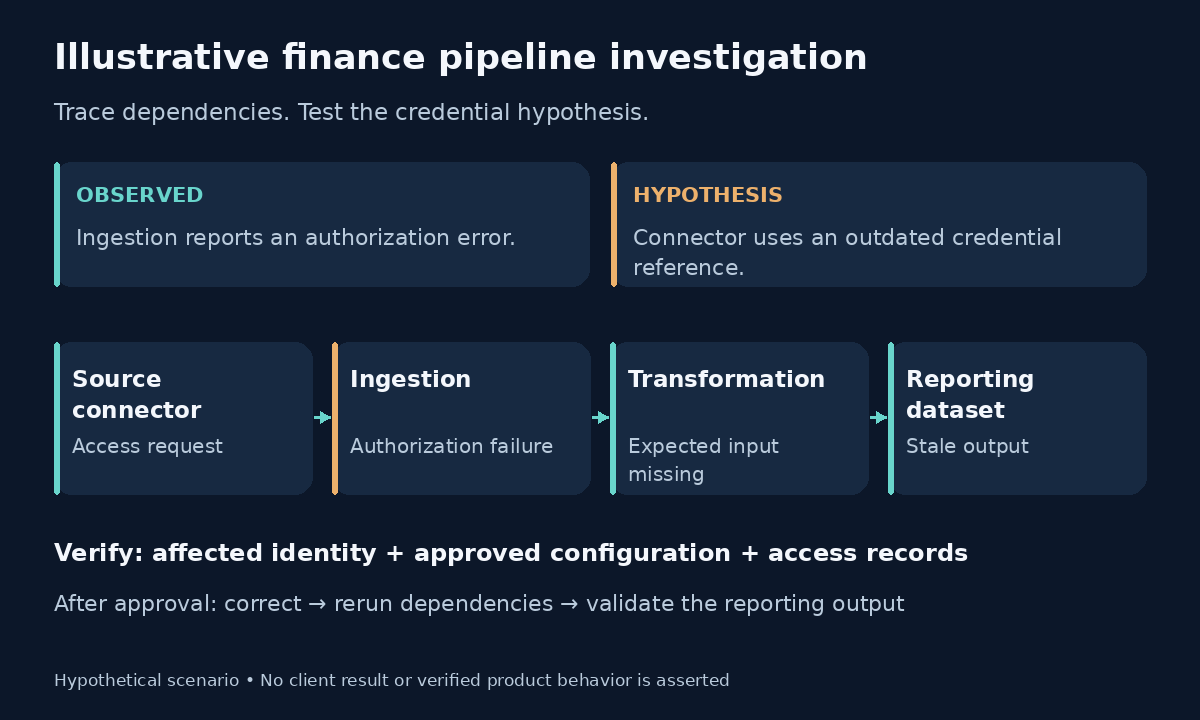
Consider a hypothetical finance reporting workflow with four components: a source connector, an ingestion job, a transformation, and a reporting dataset. The dataset is stale, and the transformation has failed because its expected input did not arrive. This example illustrates an investigation method; it is not a customer story, product screenshot, or measured ClairAI result.
The responder first checks the ingestion execution and finds an authorization error. A change record shows a credential configuration update before the first failed ingestion. That sequence supports a hypothesis: the connector may be using an outdated credential reference. It does not yet rule out a permission change, an unavailable secret, or an unrelated source service problem.
The next checks compare the affected identity and configuration with an approved working baseline, inspect the relevant access failure, and confirm whether other consumers of the source are affected. A controlled verification can then test the proposed correction under the team's change procedure. The responder records the evidence supporting the selected explanation and why the alternatives were rejected.
After an authorized correction, rerun dependencies in the appropriate order and validate the reporting dataset. A green job status alone does not establish completeness or freshness. The finance owner should confirm that the expected reporting period and records are present. Preserve the investigation and corrective action so another responder can understand both the failure and the recovery.
Know where automation can give an incomplete answer
Missing telemetry limits what any investigation can establish. Short log retention may remove the initiating event. Sampling may hide a relevant request. Stale dependency information may point to a component the workflow no longer uses. If several changes occurred together, available records may not separate their effects. The correct conclusion can be that a cause remains unconfirmed.
AI generated explanations need the same scrutiny as other hypotheses. Check whether cited records exist, whether they refer to the right environment and time, and whether the explanation introduces unsupported facts. A fluent narrative does not make a missing dependency real. Require the tool or responder to distinguish observed events, inferred relationships, and approved actions in the investigation record.
Production authority is another boundary. A suggested restart, rollback, access change, or data rerun can affect customers or alter evidence. Define which actions require approval, who can approve them, and how to reverse them where feasible. Escalate when evidence conflicts, access is insufficient, or the proposed response exceeds the responder's authority. Automation should make those boundaries visible.
Evaluate investigation quality before promising faster recovery
Begin a pilot with a defined incident class and a small set of historical cases. Include an incident with missing evidence and one with a misleading correlated change. Ask reviewers to compare the automated explanation with the accepted investigation record. Evaluate factual accuracy, source traceability, alternative hypotheses, and whether the workflow recognizes when it cannot establish a cause.
Measure time to a plausible explanation separately from time to a confirmed cause and time to service restoration. Define what each clock includes. Compare incidents with similar scope and severity, and record the effects of staffing or process changes. Do not attribute an overall MTTR improvement to RCA software without evidence that supports that attribution.
The pilot should also test operational fit. Can responders retrieve the original evidence? Can they correct an inaccurate dependency? Can they export or preserve an investigation record? Are access, retention, and approval requirements compatible with the environment? These are evaluation questions, not assumptions about a vendor. Demonstrating them matters more than a polished answer to a rehearsed incident.
Turn the finding into a durable operating improvement
A diagnosis should lead to corrective work, not simply close an alert. Record contributing conditions, detection gaps, ownership, and follow-up actions. Google's postmortem guidance emphasizes learning from incidents and tracking actions that reduce recurrence. An appropriate follow-up might improve credential rotation checks, add an upstream failure signal, or document how to validate the recovered dataset.
ClairAI's public product page describes natural-language root cause analysis, cross-system correlation, and guided remediation. Use a demonstration to examine how those capabilities apply to a representative incident and the evidence your team actually has. Confirm the required connections, access model, investigation records, and response controls directly rather than assuming that every system or workflow is supported.
A defensible RCA process connects an observed failure to a tested explanation and a controlled response. Request an AI RCA demo to review that process with ClairAI. Bring one representative incident, its available evidence, and the decisions your responders need to make, so the conversation stays grounded in your operating requirements.
Frequently asked questions
What evidence is needed to confirm a root cause?
A supported failure mechanism, traceable source records, a credible dependency path, and checks that distinguish the explanation from alternatives. Record contradictory evidence and remaining uncertainty.
What should teams verify before remediation?
Confirm the affected scope, action authority, potential impact, validation method, and reversal conditions. Preserve relevant evidence before making a change that could obscure the incident.
When should engineers escalate an automated RCA finding?
Escalate when evidence conflicts, required access is missing, business impact is serious, or the proposed action exceeds the responder's authority or established operating procedure.
Can automated RCA work with incomplete telemetry?
It can narrow hypotheses, but missing records limit confidence. State the gaps and next checks; do not label a cause confirmed when evidence cannot distinguish alternatives.
How does root cause analysis differ from alert correlation?
Correlation groups related signals. RCA evaluates a causal explanation against evidence and alternatives. A group of alerts can guide an investigation without establishing why the failure happened.
See ClairAI in action
Turn enterprise data chaos into confident, real-time decisions.
Schedule a Demo →