
Event Correlation vs Incident Correlation: What Is Different?

A quieter incident queue can conceal a coordination problem. Your platform team may have grouped repeated database alerts into one investigation, while the payments team and reporting team still work separate tickets. If those incidents share a dependency, fewer notifications alone will not tell responders who should act together or which service remains affected.
Event correlation groups related operational observations into meaningful patterns. Incident correlation links potentially related response records across services or teams. Both support investigation, but neither establishes causation alone; responders still need dependency evidence, original telemetry, impact assessment, and authorized action.
That distinction is useful for enterprise buyers, although vendors do not use the terms consistently. Some products describe alert grouping as incident correlation. Evaluate the actual input, output, and response behavior rather than purchasing a label. The practical question is whether a relationship improves a specific operational decision without hiding an independent failure.
Define the records before comparing the methods
An event is a recorded observation, such as a deployment, failed request, or completed job. An alert identifies a condition that may need attention. An incident is a response record for an interruption or degradation requiring coordinated handling. Your incident management policy should define when an observation becomes actionable, who owns it, and how resolution is confirmed.
The categories overlap in implementation. PagerDuty's incidents overview describes events creating alerts and associated incidents, while its Alert Grouping documentation describes consolidating related alerts into an incident. Its separate Related Incidents feature surfaces potentially related incidents across services. These are concrete product behaviors, not universal definitions or evidence that every correlation platform implements the same workflow.
| Record level | What it represents | What correlation should preserve |
|---|---|---|
| Event | Observed change or activity | Original payload and observation time |
| Alert | Condition requiring assessment | Scope and grouping rationale |
| Incident | Accountable response record | Owner, impact and recovery checks |
Preserve these levels in reporting. A decrease in alert count may mean deduplication changed, thresholds changed, or events stopped arriving. It does not by itself establish fewer incidents, better service availability, or a shorter restoration interval. Keep the underlying observations accessible so responders can examine what a grouped record contains and what it excludes.
What event correlation should retain
Event correlation can associate observations using shared resource identifiers, message content, topology, or timing. Deduplication is narrower: repeated notifications for the same condition become one tracked alert. Broader correlation can connect different symptoms. Suppression is another decision altogether, because it controls whether a notification reaches responders. Ask which operation a rule actually performs.
Begin with consistent environment, service, resource, and observation-time fields. Keep ingestion time separate when delayed delivery matters. A production failure and a test failure should not merge merely because their messages match. Logs, metrics, and traces provide different views of activity; OpenTelemetry's signals documentation describes those telemetry categories without promising that instrumentation automatically supplies a complete dependency model.
Choose grouping windows against the workload's behavior, then test their consequences. A long window can combine unrelated failures; a short window can fragment one failure into repeated pages. Scheduled jobs also create predictable bursts that resemble incidents. Retain rule versions and reasons for grouping so a reviewer can reconstruct why an observation entered a particular investigation.
What incident correlation adds to the response
Incident correlation operates on response records that may already have owners, priorities, and affected services. The relationship might suggest a shared upstream failure, a dependency impact, or simply a useful coordination opportunity. Linking records should not erase their independent recovery checks. A downstream team may still need to repair delayed work after an upstream service recovers.
Keep the rationale visible beside the relationship. Shared creation times are a lead; an observed dependency failure and matching affected requests are stronger context. PagerDuty documents both machine-learning-based and dependency-aware Related Incidents. Its configuration and availability conditions are product-specific. A suggested relationship remains something responders should assess, not permission to merge records or execute a change automatically.
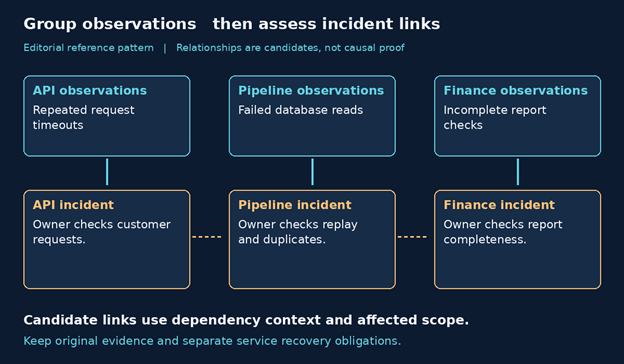
Separate linking from merging. A link can support a common response channel while retaining individual owners. A merge may alter notification, assignment, or reporting behavior depending on the system. Before consolidating records, confirm which impact statements, acknowledgments, and service-level obligations remain visible. Otherwise, a cosmetically smaller queue can leave a business service without accountable follow-through.
A hypothetical cross-domain failure
Consider a hypothetical retailer whose order API, inventory pipeline, and finance report all depend on one database service. Request timeouts create alerts for the API. The pipeline records failed reads. Finance raises an incident because its scheduled report is incomplete. These are illustrative conditions, not a ClairAI deployment or a customer result.
First, responders group repeated timeout observations within the API investigation while preserving affected request identifiers. Next, they link the API, pipeline, and finance incidents as potentially related. A dependency map suggests the database as a common point, but the team checks the actual affected environment and workload before accepting that explanation. An unrelated reporting defect could coexist.
Suppose database telemetry then confirms connection failures on the relevant path, and the pipeline's failed reads reference that database. The evidence supports coordination around the database investigation. It still does not identify the precise underlying defect. Engineers retain competing explanations, notify downstream owners, and select an approved mitigation based on impact and action risk.
Restore each affected service deliberately
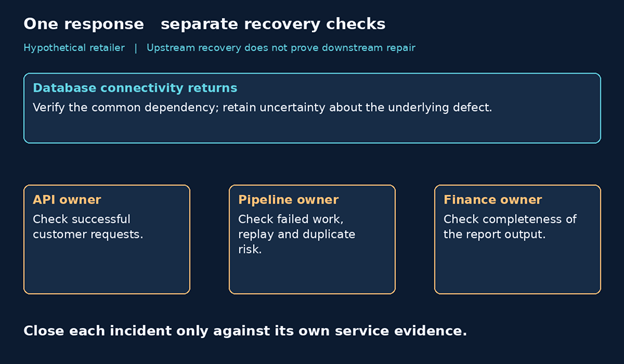
After database connectivity returns, the API owner checks successful customer requests. The pipeline owner verifies whether failed work requires replay and whether replay could duplicate records. Finance checks the report's completeness rather than assuming upstream recovery repaired the output. The incidents can share a response while closing against different evidence. Correlation helps identify those obligations; it does not discharge them.
Use evidence to decide the next action
Before remediation, identify the affected scope, the proposed failure mechanism, and the observations supporting the action. Confirm the operator's authority, potential side effects, and a recovery or rollback path. Google SRE's Effective Troubleshooting describes testing hypotheses against observations. An urgent mitigation can precede complete causal understanding, but document that uncertainty rather than presenting a temporary recovery as proof.
| Decision | Evidence to inspect | Response control |
|---|---|---|
| Group observations | Matching scope and relevant attributes | Retain original records |
| Link incidents | Dependency context and affected paths | Keep service ownership |
| Remediate | Action rationale and side effects | Require authority and recovery checks |
| Close each incident | Service-specific recovery evidence | Do not infer downstream recovery |
Escalate when service impact crosses your response policy, ownership is unclear, required access is missing, or the proposed action exceeds the current responder's authority. Do not wait for a convincing causal narrative if customers remain affected. A useful escalation includes the incident links, current impact, original evidence, attempted actions, and the decision that requires another team.
A source-grounded comparison for platform evaluators
Use three references for different questions. PagerDuty's Alert Grouping documentation shows alerts consolidated into an incident. Its Related Incidents documentation shows associations among response records. OpenTelemetry explains the signals that can contribute observations. Taken together, they support evaluating record granularity and evidence provenance separately. They do not establish ClairAI interoperability, causal accuracy, or a guaranteed operational result.
For a product evaluation, replay a reviewed incident set with known service boundaries. Include an unrelated failure during the same period and one late-arriving observation. Ask reviewers to identify incorrectly combined records, missed relationships, and whether they can inspect the original evidence. Record disagreements and corrections. This tests usefulness under your conditions rather than the appeal of a demonstration.
Inspect the operational behavior behind the relationship
During a demonstration, change one candidate relationship and follow what happens to each team's queue. Confirm whether the change affects acknowledgments, paging, priority, or only the displayed context. Test who can add and remove links, whether a correction is recorded, and whether a responder can recover the original record after a mistaken merge. These are acceptance requirements to verify, not features assumed to be present.
Also inspect the handover between shifts. The receiving engineer should be able to distinguish observed facts from the current hypothesis, identify the coordinating owner, and see which dependent services still need checks. If that information exists only in a temporary chat thread, the correlation view has not preserved the response state. Agree on the durable record before expanding the evaluation.
Treat absence of evidence carefully. A quiet downstream service might be unaffected, or its telemetry might be delayed or disconnected. Ask the owner to verify coverage before treating silence as confirmation. Record unavailable evidence beside the proposed relationship so reviewers do not mistake an incomplete view for an unaffected service. That distinction matters when deciding whether another team should join the response.
Measure coordination without hiding limitations
Measure alert grouping quality separately from incident relationship quality. Track false combinations, missed relationships, and time spent correcting them. Then measure operational intervals with named start and end events, such as acknowledgment, mitigation, and restoration. Define MTTR explicitly because teams use the abbreviation for different intervals. Do not compare averages across different severities or workloads without explaining the population.
Missing telemetry, stale topology, clock differences, and inconsistent service identities can all weaken a relationship. Model-generated explanations introduce another review requirement: the prose must point to inspectable records. Keep a way to reject a suggestion and recover an incorrectly grouped alert. Restrictions on data access also matter; a relationship visible to one team may reveal information another team cannot access.
Choose visibility that supports accountable response
ClairAI's public platform description includes cross-system correlation and dependency awareness. Treat those descriptions as the starting point for a demonstration of your required evidence and ownership boundaries. The existing intelligent alerting article provides additional context on notification overload. Neither public description substitutes for a verified integration, an approved customer case, or testing against your own incident records.
Bring one representative cross-platform incident to the evaluation. Ask how observations remain traceable, how incident relationships are explained, and how each service owner verifies recovery. Discuss cross-platform incident visibility through ClairAI's homepage contact form, with your current record types and escalation requirements. The goal is a response your teams can audit, not merely a smaller number of notifications.
Frequently asked questions
Is event correlation the same as incident correlation?
Not consistently. This guide distinguishes grouping observations from linking response records. Vendor terminology varies, so inspect each product's inputs, outputs and ownership behavior.
Does correlation establish the root cause?
No. A relationship can guide investigation, but responders still need a credible failure mechanism and confirming or disconfirming evidence before calling the cause established.
What evidence is needed before remediation?
Verify affected scope, supporting observations, action authority, side effects and recovery checks. Document uncertainty if an urgent mitigation proceeds before the underlying cause is confirmed.
When should engineers escalate a correlated incident?
Escalate when impact, missing ownership, required access or action risk exceeds your response policy. Include original evidence, linked records and the decision another team must make.
Should related incidents always be merged?
No. Linking may support coordination while preserving owners and recovery obligations. Merge only after checking how the system handles assignments, notifications, history and closure.
See ClairAI in action
Turn enterprise data chaos into confident, real-time decisions.
Schedule a Demo →