
Incident Investigation: A Step-by-Step Guide for SRE Teams
When an incident begins, the hardest problem may be deciding what everyone should do next. One engineer sees a deployment, another suspects storage, and a business team reports missing transactions. Without shared scope and ownership, technically capable responders can pursue conflicting explanations while the service continues to deteriorate. A useful incident investigation creates a record that supports decisions under pressure, not just a collection of screenshots.

What the investigation must establish
Incident investigation begins by confirming user impact, assigning response ownership, preserving time-stamped evidence, and testing plausible causes. During an active outage, prioritize authorized mitigation, record decisions, and verify recovery before separating confirmed findings from hypotheses in a later incident review.
Investigation and incident management have related but different jobs. Investigation develops and tests explanations. Incident management coordinates people, authority, communications, and recovery. A responder may perform both roles in a small event, but the responsibilities still need to be explicit. An accurate diagnosis arriving after an avoidable communication failure does not constitute an effective response.
Define success in operational terms. The affected service should return to an agreed condition, important consumer workflows should be checked, and unresolved risks should have an accountable owner. A complete causal explanation may require later analysis. Do not delay an approved containment action solely because the team has not yet explained every contributing factor.
1 Confirm impact and declare ownership
Start with expected and observed behavior. Name the service or data product, affected users, first observed failure, and evidence of business impact. Distinguish a monitoring failure from a customer-facing failure, while recognizing that missing visibility can itself require attention. Record uncertainty explicitly: an unknown population is not the same as an unaffected population.
Assign an incident lead and name the person authorized to coordinate production changes. Identify who will communicate with stakeholders and keep the incident record current. Google SRE's Managing Incidents chapter describes separating coordination, operational work, and communications. Adapt those responsibilities to your organization rather than assuming that the most senior engineer should simultaneously diagnose, approve changes, and answer every update request.
Apply your established severity policy, including customer harm, data integrity, critical deadlines, and the breadth of the failure. Bring in the relevant business owner when severity depends on a process engineers cannot assess alone. State the next update time and communication channel. Early ownership prevents parallel responders from applying changes that invalidate one another's observations.
2 Preserve the first useful evidence
Create a single incident record with a consistent time reference, normally including the timezone and clock source. Capture the last known good state, initial symptoms, affected environment, recent changes, and links to original observations. Distinguish when an event occurred from when monitoring received it. Delayed ingestion and unsynchronized clocks can otherwise reverse an apparent sequence.
Collect focused evidence before restarting components or replaying work, when doing so will not delay urgent mitigation. Preserve relevant errors, deployment identifiers, request or run identifiers, and dependency health. Follow access and retention policies; broad diagnostic exports can contain customer data. Keep original records available and use redacted excerpts for wider communication rather than copying sensitive payloads into a shared chat.
Evaluate each monitoring signal based on the specific insights it provides during an incident investigation. OpenTelemetry distinguishes metrics, logs, and traces: measurements reveal changes, event records provide detail, and traces connect operations along a request path. None guarantees full coverage. Record sampling, retention, missing collectors, and inaccessible systems alongside the evidence so an incomplete view does not appear conclusive.
| Runbook step | Evidence to retain | Decision supported |
|---|---|---|
| Confirm impact | Expected behavior and affected scope | Set severity and ownership |
| Preserve evidence | Times, identifiers and original errors | Keep observations traceable |
| Test explanations | Predictions, comparisons and results | Reject or retain hypotheses |
| Approve mitigation | Owner, action and stop condition | Limit intervention risk |
| Verify recovery | User checks and unresolved work | Restore service and assign follow-up |
3 Map the affected path and test explanations
Trace the affected workflow from the consumer toward its dependencies. Check which service version, dataset partition, account, or region participates in the failure. Compare a failing path with an unaffected path where that comparison is meaningful. A dependency diagram is useful only if it reflects the relevant deployment and current ownership, not an architecture that existed before the last release.
Write a short hypothesis that predicts an observable result. For example, if a connection limit is causing errors, the affected dependency should show relevant exhaustion evidence during the same request window. Search for evidence that would disprove the explanation as well as support it. A nearby deployment or correlated alert is a lead, not proof of cause.
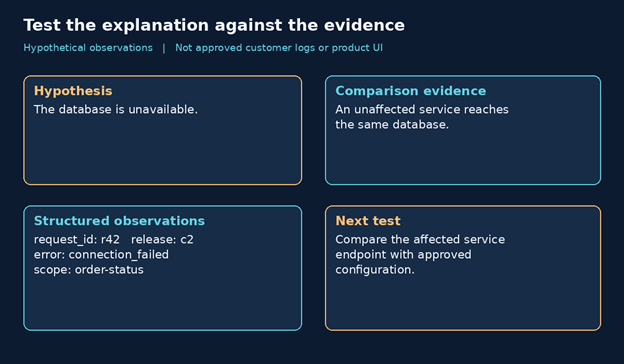
Choose a low-risk test first, such as inspecting configuration, comparing request paths, or reviewing dependency responses. Production experiments require appropriate authority and a defined stop condition. Record the test, expected result, actual observation, and interpretation. Google SRE's Effective Troubleshooting chapter treats diagnosis as iterative hypothesis testing and warns against confusing correlation with causation; apply that discipline without turning an outage into an uncontrolled experiment.
Maintain a compact list of open questions beside the hypotheses. Give each question an owner and the observation needed to answer it. If an engineer leaves the response, another person should be able to continue without repeating completed tests. Record negative findings with clear limits: normal performance in one region does not confirm health elsewhere, and successful reads do not guarantee that write operations are working properly. This record makes uncertainty usable instead of allowing an early assumption to become an accepted incident fact.
4 Mitigate with a recorded decision
Before a disruptive action, establish what it changes, who approves it, how success will be measured, and what happens if it fails. Consider whether a restart loses transient evidence, a replay creates duplicates, or a rollback leaves data incompatible with an earlier application version. An operationally familiar action can still be inappropriate for the current failure.
Prefer a bounded intervention with a known recovery path when the situation allows it. Assign one change owner and record the action time so its effects can be separated from other events. If urgent containment must proceed with incomplete diagnosis, label the reasoning accordingly. Reducing harm is a valid operational decision even when the final cause remains under investigation.
A hypothetical investigation with a decision trail
Consider a hypothetical order-status service whose requests begin failing after a configuration release. This is an editorial example, not a ClairAI deployment or customer result. At 09:00 UTC, a synthetic customer check fails. At 09:03, the incident lead records affected requests and names the service owner. At 09:06, responders preserve the release identifier and dependency error evidence.
The team initially suspects a database outage. Comparison with an unaffected service shows that the database is responding, while the changed service cannot establish its expected connection. At 09:10, a configuration comparison reveals an incorrect endpoint. That observation supports a narrower explanation than the original database-outage hypothesis. It also identifies the responsible owner without assuming that every downstream alert represents a separate failure.
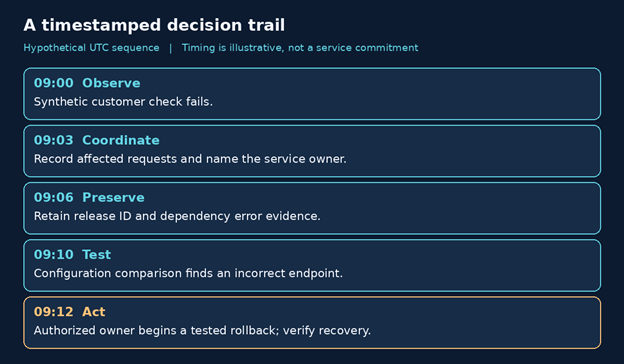
At 09:12, the authorized change owner begins a previously tested configuration rollback. The record identifies its purpose, approval, and verification conditions. These illustrative timestamps explain the sequence; they are not a response-time benchmark or a promised resolution. The team would still need to observe the restored request path, check affected business transactions, and assess any remaining backlog before declaring recovery.
5 Escalate before uncertainty becomes unmanaged risk
Escalate when impact exceeds the current response team's authority, a critical deadline is threatened, data may be corrupted, or the proposed action crosses an ownership boundary. Bring in specialist response teams for suspected malicious activity or privacy concerns according to policy. Do not wait for certainty if the potential consequence requires a different decision maker.
An escalation should carry the current impact, incident owner, evidence links, hypotheses tested, actions taken, and the decision required. State what remains unknown and the next review time. ClairAI's intelligent alerting article discusses impact and context; the practical extension is an escalation packet that lets another team act without repeating the entire investigation.
6 Verify recovery and preserve learning
A falling error chart is encouraging but insufficient. Verify the affected user journey, dependency behavior, and any interrupted business work. Reconcile failed or uncertain transactions where appropriate, and inspect backlog recovery separately from immediate request success. Define an observation period suitable for the service rather than using a universal number of quiet minutes.
Record recovery time under a stated definition. If the organization reports MTTR, specify whether the measure means time to restore service, resolve an incident, or repair a component. Separate restoration from final investigation closure. Google SRE's incident-response workbook emphasizes coordinated practice and learning; an incident review should convert the evidence into owned follow-up work, not merely restate the chronology.
Evidence boundaries and an operating decision rule
Use coordination evidence to establish authority, runtime evidence to test explanations, and consumer checks to establish recovery. Google SRE's incident-management and troubleshooting references support these distinct responsibilities; OpenTelemetry defines the signal types used in the evidence trail. This framework is a recommended operating method, not proof that a tool can infer causality or authorize production changes.
Incomplete instrumentation, clock differences, sampling, and outdated dependency maps limit the conclusions available. An AI-generated explanation should identify its supporting observations and unanswered questions. ClairAI publicly describes natural-language root cause investigation, cross-system correlation, and guided remediation. Evaluate those descriptions against a representative incident, the exact available telemetry, and your access model rather than assuming universal integrations or automatic execution.
Put the runbook through an operational test
Rehearse the process with an agreed scenario before relying on it during an outage. Check whether responders can establish scope, preserve evidence, reject an incorrect explanation, route an escalation, and verify recovery. Include a handover to another engineer. The investigation record should be understandable without the original responder narrating every decision.
Bring a representative service path, an anonymized incident record, and the decisions your responders must make to a ClairAI discussion. See an investigation walkthrough through the ClairAI homepage to assess how the available evidence supports your operating process. The goal is an investigation your teams can audit and continue, with clear ownership from the first report through verified recovery.
Frequently asked questions
What should an SRE do first during incident investigation?
Confirm user impact, assign response ownership, and open a shared incident record. Preserve useful evidence while prioritizing authorized actions that limit harm.
Must root cause be proven before mitigation?
No. Urgent containment may precede a complete explanation. Record the uncertainty, approval, intended effect, and recovery checks, then continue causal analysis after service restoration.
What belongs in an incident evidence trail?
Retain timestamps with timezone, original observations, relevant identifiers, hypotheses, test results, approvals, actions, and recovery checks. Follow retention and access policies for sensitive records.
When should engineers escalate an incident?
Escalate when impact, uncertainty, deadlines, or proposed changes exceed the team's authority or expertise. Include the decision required, current evidence, and accountable incident owner.
Can AI explanations replace investigation notes?
No. AI output should link to supporting evidence and identify uncertainty. Human-owned records remain necessary for change approval, handover, recovery verification, and follow-up accountability.
See ClairAI in action
Turn enterprise data chaos into confident, real-time decisions.
Schedule a Demo →