
AI Incident Management: From Detection to Resolution

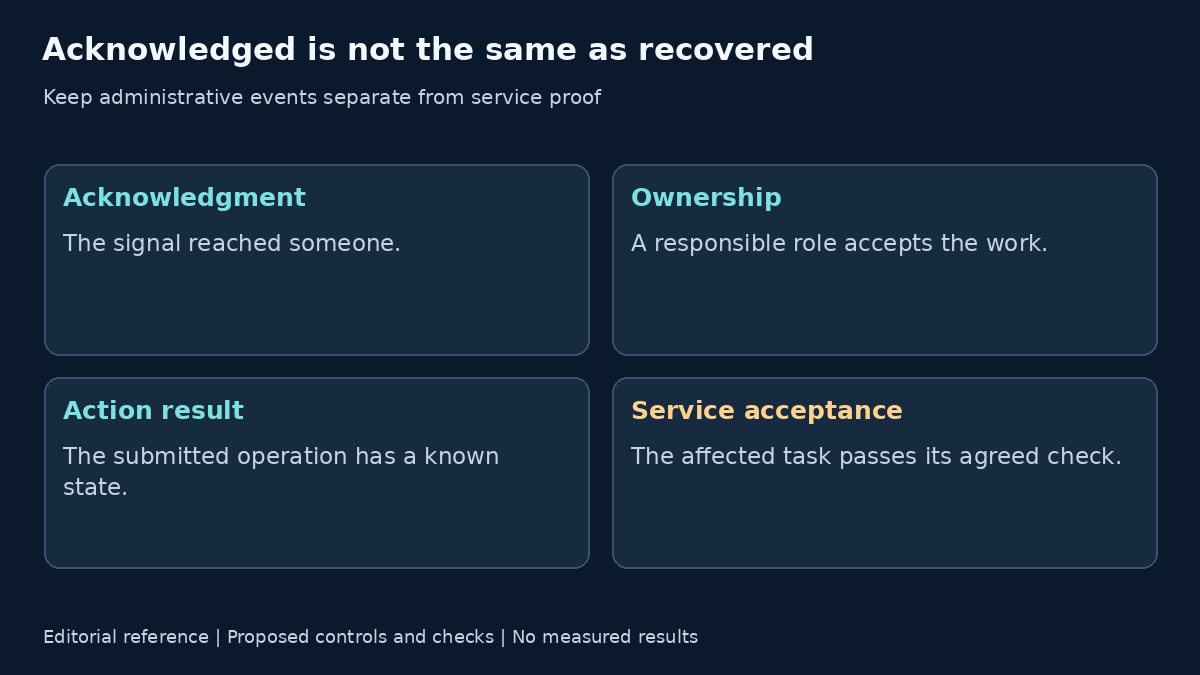
The alert is acknowledged, a responder is assigned and a generated summary is posted. Meanwhile, customers still cannot upload documents. Those administrative events show that incident work has started; they do not show whether anyone has established impact, authorized a remedy or checked recovery. AI incident management needs to preserve those distinctions throughout the service interruption.
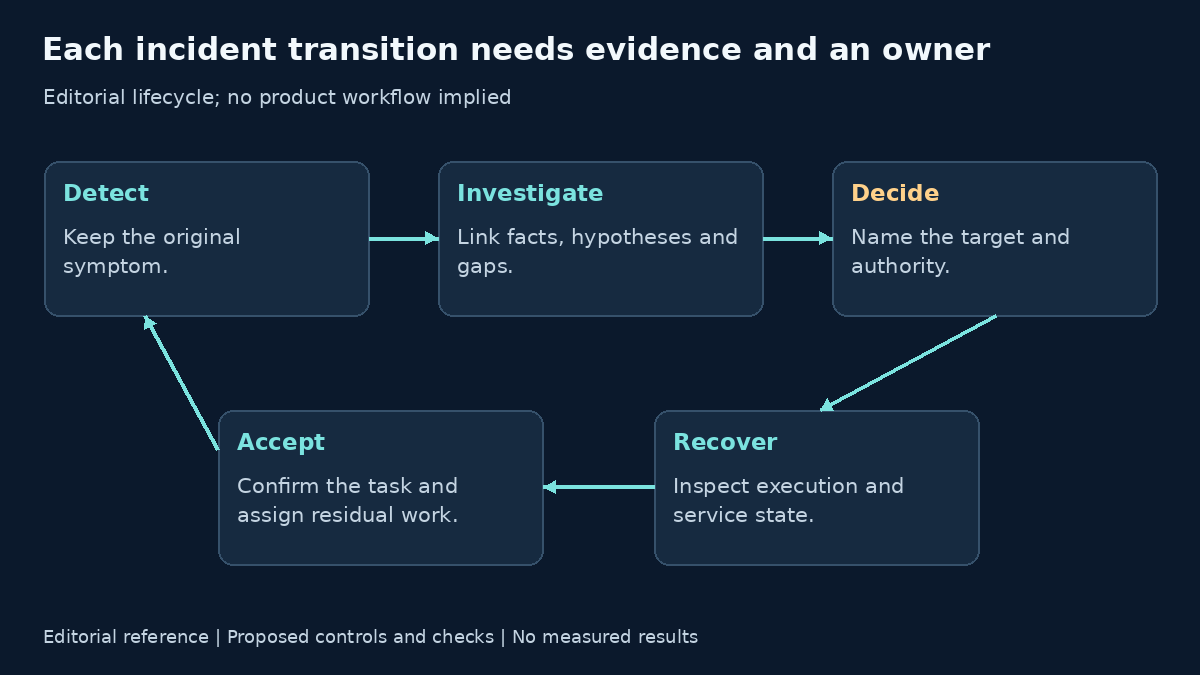
AI incident management can assist detection, triage, evidence gathering, ownership routing, recommendations, and review. Keep hypotheses distinct from verified facts, require appropriate authority for changes, and close an incident only when the affected service meets its agreed recovery acceptance criteria.
Make incident state describe the service problem
Define the states an incident can occupy using observable conditions. Detected means a signal requires attention. Investigating means an owner is examining impact and evidence. A proposed action is awaiting a decision. Recovery is being checked. Resolved means the agreed service acceptance condition holds. Your exact names can differ; the underlying transitions should remain inspectable.
Avoid allowing one event to stand for several states. Acknowledgment is not an impact assessment, and an assigned engineer is not necessarily the person authorized to change the affected dependency. Record the operational decision that each transition represents. This gives responders and business stakeholders a shared account of what is happening without presenting activity as proof of recovery.
Keep the customer-facing symptom attached to the record. A group of infrastructure alerts may change as the incident develops, but the service problem that prompted the response can persist. If AI reorganizes the signal set, retain the link to the affected customer task. Otherwise, an apparently cleaner incident queue can hide work that still needs an owner.
| State | Evidence of progress | Accountable decision |
|---|---|---|
| Detected | A signal needs service attention | Assign initial investigation |
| Investigating | Impact and hypotheses linked to records | Choose the next discriminating check |
| Action proposed | Target, expected effect and uncertainty | Approve, reject or request more evidence |
| Recovering | Execution state and service test | Continue monitoring or escalate |
| Resolved | Acceptance condition and residual-work disposition | Accept recovery and assign follow-up |
Give triage a bounded task
AI can help assemble related observations, identify candidate owners and prepare an initial impact summary. Check the associations before consolidating incidents or dismissing an alert. Two services changing at similar times may have independent faults. Alert correlation is useful when it narrows inspection while preserving the original signals and a route to separate incorrectly grouped work.
State what the initial impact assessment actually establishes. An increase in upload errors may affect one customer segment, one file type or a shared dependency. Those alternatives imply different response priorities. Ask for evidence that distinguishes them. If the scope remains uncertain, record that condition and identify the next check instead of filling the gap with an invented impact statement.
The ClairAI intelligent-alerting article provides context on signal prioritization. The lifecycle question continues beyond prioritization: which owner accepts the incident, what decision follows and how will its effect be verified? Treat that connection as a workflow requirement rather than assuming an improved alert automatically produces a complete response.
Maintain an evidence record that survives a shift change
For each material observation, retain its source, affected scope and relationship to the current hypothesis. Separate facts from proposed explanations. A generated timeline should distinguish when a record was received from when the underlying event occurred. Late telemetry can change the apparent sequence, and responders should be able to revise an explanation without losing the earlier decision history.
Keep competing explanations visible until a useful check resolves them. A release, an access change and a failing dependency may all be plausible leads. The AI contribution should reduce the effort of finding and testing relevant records. It should not make the team defend the first fluent diagnosis simply because that explanation was written into the incident channel early.
When source coverage is incomplete, show the gap. A missing trace or inaccessible dependency can limit what the investigation supports. Preserve the question that remains unanswered and assign it to someone who can obtain the needed evidence. The absence of a visible error is not enough to declare an unobserved component healthy.
Distinguish recommendation from authority
A recommendation should name its target, intended effect, evidence and remaining uncertainties. Review it against current service conditions and permissions before an operation changes production. An engineer approving a known procedure may still need to reject a particular target or timing. Approval belongs to a specific operational proposal, not to the general idea that AI can recommend a fix.
Google's SRE guidance on AI in reliable operations distinguishes assistance from higher levels of autonomy. This supports evaluating investigation and execution separately. It is not evidence that an external product implements Google's controls. Choose the permitted level according to demonstrated procedures and enterprise policy, and retain a responsible human role where the proposed action requires one.
Prepare a stop path before execution. If new evidence contradicts the proposed remedy or another responder changes the affected resource, the workflow needs to pause and reassess. Record commands already submitted and results still pending. A system that keeps producing new suggestions without knowing which changes are underway can make coordination harder during an incident.
Follow a hypothetical document-upload outage
Suppose an enterprise upload service returns errors while a background document-indexing queue grows. In this illustrative case, a storage access change and an application deployment occurred near the first alert. The initial AI summary proposes a deployment rollback. That proposal is a hypothesis. The incident owner first needs to establish which upload path is failing and whether indexing is a cause or a consequence.
The investigation links affected requests to storage access denials and checks a comparable path using another permitted identity. The team also examines whether the new release changed the failing call. Evidence supports reviewing the access change before choosing a rollback. The incident record retains both the original proposal and the reason the investigation moved to another explanation.
The authorized owner approves a narrowly scoped access correction under the organization's procedure. Before submission, the execution path checks the current target and relevant prerequisites. If the operation's result is uncertain, the team inspects state before repeating it. None of these steps is a claim about a real ClairAI customer or a confirmed implementation.
Recovery is then assessed through an approved upload test and the dependent document-processing outcome. The indexing queue receives its own owner if accumulated work remains. The incident may move from active mitigation to monitored recovery while that work continues. A resolved infrastructure alert should not erase a business task whose acceptance condition still fails.
| Hypothetical event | What it establishes | What still needs checking |
|---|---|---|
| Upload errors observed | A service symptom exists | Affected path and customer scope |
| Rollback recommended | A candidate action was proposed | Whether release evidence supports it |
| Access denials inspected | A supported failure lead | Current permission change and authority |
| Correction submitted | An operation was attempted | Known result and service acceptance |
| Alert cleared | One signal changed | Upload and dependent processing outcomes |
Close the loop with the receiving operation
Agree on the recovery condition early enough to guide the response. It should cover the affected service task and any material residual work. Use a representative check, approved production observation or another validated acceptance method. Do not let the same alert's disappearance become the sole proof of resolution if the original failure can remain hidden behind it.
Document who accepts recovery and what remains open. A separate problem record may investigate recurrence prevention after service is restored. That distinction allows incident response to end under a defensible condition without pretending every underlying engineering issue has been eliminated. Assign owners and follow-up decisions rather than automatically closing all related tasks together.
Measure transitions that represent actual progress
Track time to ownership, impact assessment, decision, execution and accepted recovery using defined events. If you report MTTR, specify its meaning and which intervals it includes. Changes in incident mix or reporting rules can alter the measure without changing response quality. Compare similar cases and inspect unresolved work alongside completed incidents.
Review incorrect groupings, unsupported summaries, unnecessary escalations and proposals rejected for missing context. These reveal where AI assistance creates work or misdirects attention. Keep human review effort in the operating assessment. A faster first summary can be useful, but its value depends on whether responders can trust and act on the evidence it organizes.
Use the sources to define an evidence boundary
Google's incident-management guidance explains explicit incident roles and a shared operating record. Its AI guidance distinguishes investigation support from execution authority. Together, those references support evaluating ownership and decision control across the lifecycle. They do not establish a product's accuracy, access coverage or recovery performance in your environment.
ClairAI's public site presents detection, investigation and guided remediation capabilities. Ask for a demonstration that begins with the original signal and ends with inspectable recovery evidence. Require the unavailable-source and rejected-action paths too. A product tour showing only the successful recommendation leaves the most consequential operational boundaries untested.
Finish the customer task before closing the incident
Turn the reviewed incident into a test case
Retain an approved version of the incident's evidence and reviewed decisions for later evaluation. Include the misleading early signal, the rejected recommendation and the recovery check that changed the outcome. These details let the team test whether a later configuration can handle the same ambiguity rather than merely reproduce the final explanation after every answer is already known.
Assign ownership for corrections to summaries and operational knowledge. If an earlier diagnosis was wrong, updating the final incident note may be insufficient when the same text has already entered a runbook or a knowledge source. Track where the incorrect claim was reused and correct those references. Learning from incidents requires a reviewed information change, not an assumption that accumulated incident text is automatically reliable training material.
Start with one service interruption and define the evidence required at each transition. Give every unresolved decision an owner, preserve uncertainty and verify the affected task after a permitted remedy. AI assistance is useful when it helps the next responder understand and advance that work while the organization retains control of consequential decisions.
Book an incident intelligence demo around a complete incident lifecycle. Bring an impact question, a disputed recommendation and the acceptance check your service owner would require before declaring recovery.

Frequently asked questions
What does AI incident management automate?
Depending on the verified deployment, it can assist signal review, triage, evidence gathering, summaries, routing and recommendations. Execution requires separately established permissions and operating controls.
Does acknowledgment mean an incident is under control?
It establishes that someone received the alert. Impact, accepted ownership, an operational decision and recovery still need their own evidence.
How should conflicting AI and engineer hypotheses be handled?
Keep both explanations linked to their evidence and identify a check that distinguishes them. Do not select an explanation solely because of its author or confidence score.
What evidence should precede remediation?
A supported impact assessment, a reasoned action proposal, a defined target, appropriate authority and a recovery acceptance check. Record uncertainties that affect the decision.
When can the incident be closed?
When the agreed service recovery condition is met and an accountable owner accepts the remaining-work disposition. Administrative completion or a cleared alert alone is insufficient.
See ClairAI in action
Turn enterprise data chaos into confident, real-time decisions.
Schedule a Demo →