
How to Reduce MTTR: A Practical Incident Investigation Framework
Learn how to reduce incident resolution time through evidence-led investigation, clear ownership, bounded mitigation and verified recovery.
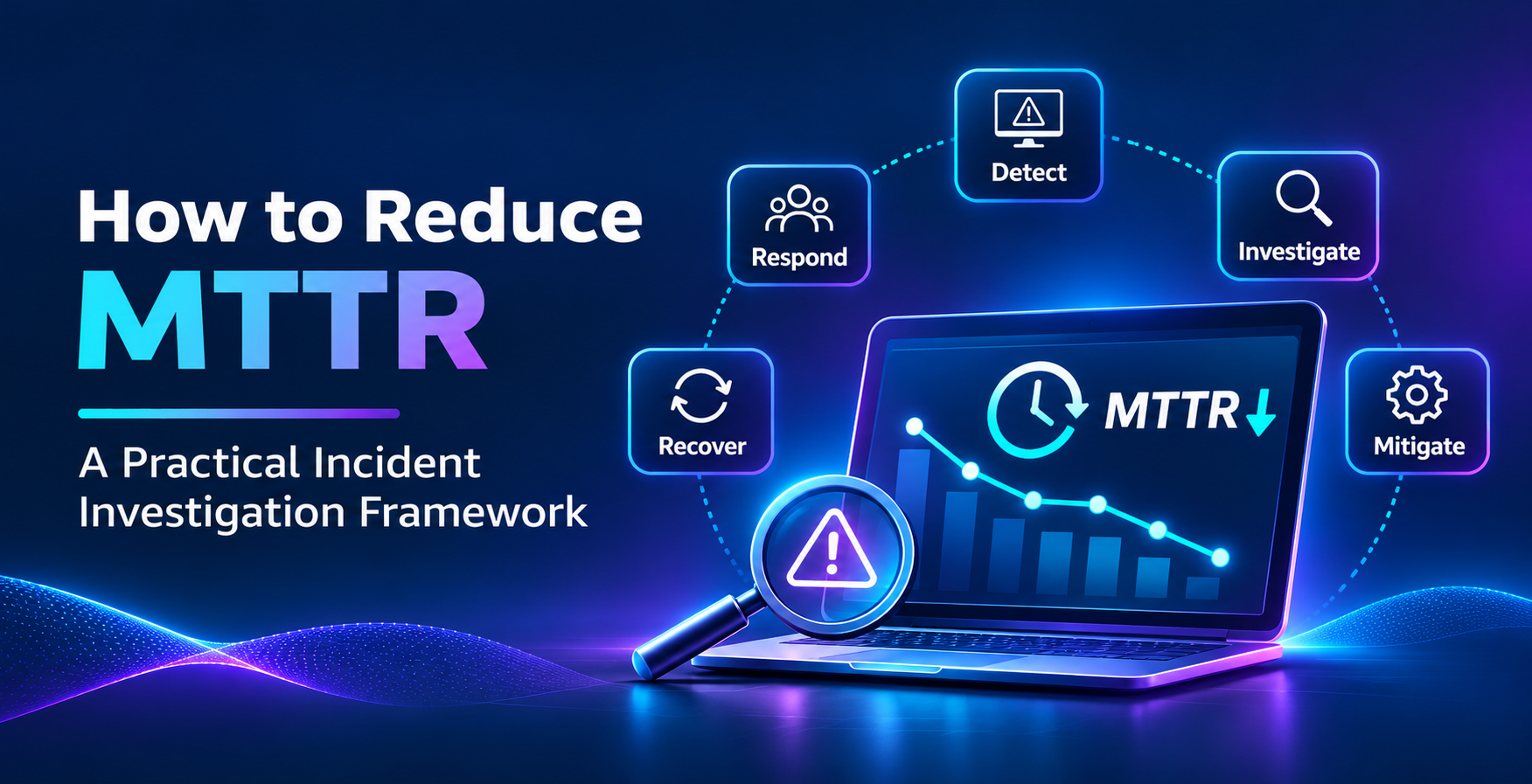
An incident begins when customers notice delayed transactions. Monitoring raises an alert, an engineer investigates an upstream dependency, and service appears healthy after a rollback. Yet a queue of unfinished work remains. The team must decide whether the incident ended when requests recovered or when delayed transactions were reconciled. That distinction changes the reported mean time to resolution (MTTR).
Why MTTR needs a definition
MTTR can mean mean time to resolve, repair or recover. Teams should document the exact starting event, ending event, incident population and reporting period. Averages alone hide severe outliers. Review median duration, upper-percentile cases and the longest incidents alongside the average.
A useful measurement policy also addresses reopened incidents. If a service recovers for five minutes and fails again because the same unresolved condition persists, counting two short incidents can make performance appear better than it is. Define a stability window and document how recurrence is handled. For data services, record whether the recovery point is infrastructure availability, successful job execution or delivery of correct data to consumers. These are materially different promises. An incident register should retain severity, affected service, duration, restoration evidence and exceptions to the calculation. The objective is comparability, not a flattering number.
Break the response into measurable stages
Capture the time of first customer impact, first reliable signal, incident declaration, owner acceptance, first tested hypothesis, mitigation and restoration acceptance. Separate alert-routing delay from evidence gathering, approval waits, action execution and validation. A short detection interval does not guarantee a short outage.
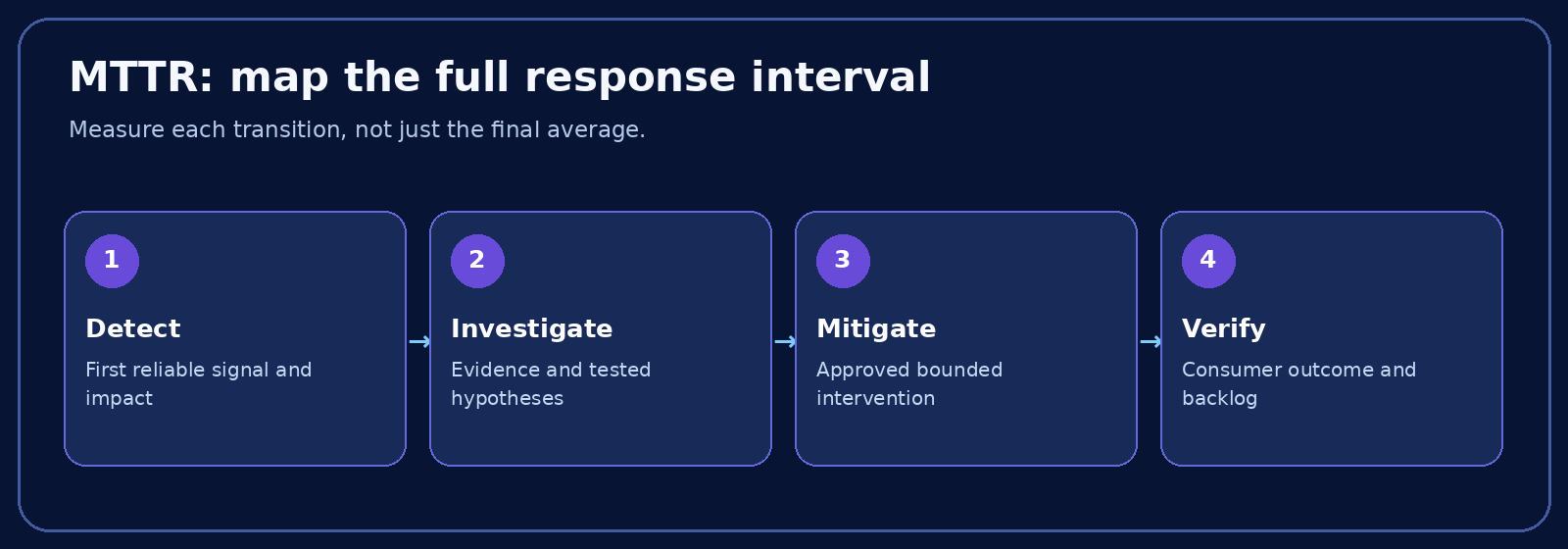
Keep a shared timeline that reflects what responders knew at the time. Link observations to permitted logs, traces, metrics, deployment records and incident tickets. Mark uncertain timestamps explicitly instead of treating an estimate as fact.
A stage-based timeline makes improvement work actionable. Detection time shows whether monitoring noticed a real symptom. Routing time reveals whether the alert reached an accountable team. Investigation time captures the path from accepted ownership to a supported diagnosis or safe mitigation. Approval time exposes waits for a change decision. Validation time measures how long it took to prove the service commitment was restored. Record overlapping work rather than adding every team's activity into an inflated total. In reviews, identify the critical path: which wait actually delayed restoration? A ten-minute parallel investigation may not matter if a thirty-minute approval queue determined the outcome.
Start investigation with customer impact
Define the affected user journey or data delivery commitment before narrowing the suspected component. Identify which regions, accounts, services and customers are affected. Compare the onset with changes and dependency behavior. Metrics help quantify scope, traces show request paths, logs document events and change records identify candidate explanations.
Treat an apparent cause as a hypothesis. A deployment and a database latency spike occurring together do not prove causation. Record what was tested, what was ruled out and the scope of each negative finding. When multiple teams investigate, keep one decision record.
For an application outage, ask which transactions failed, how often, and for whom. For a data pipeline, establish the last correct output, the freshness requirement and whether downstream decisions used incomplete records. These questions constrain the search and prevent responders from chasing unrelated alerts. Build a hypothesis table with an observation, candidate explanation, disconfirming test and owner. For example, if connection saturation is suspected, compare pool utilization and request timing before and after the onset. If a release is suspected, compare affected and unaffected regions. The goal is not to collect every signal; it is to choose the next test that separates competing explanations.
Give every handoff an accepted owner
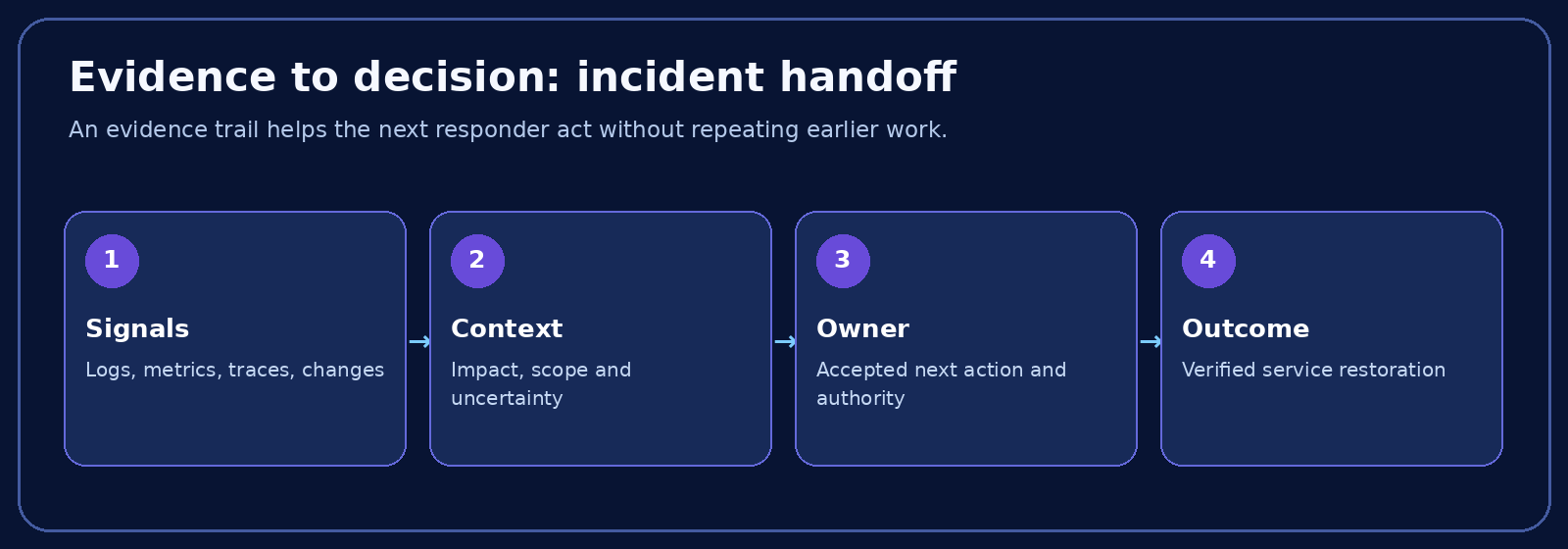
A coordinator should maintain severity, next decision, escalation path and current customer impact. Parallel investigations are useful only when each has an owner and expected output. A handoff should state what happened, what was tested, what evidence is missing, who has authority to act and when the next update is due.
Escalation should not depend on an engineer noticing an unanswered message. Define an acceptance window and alternate owner for unavailable specialists. Separate technical investigation ownership from business approval for disruptive changes.
Use a short, structured handoff during incident bridges: current impact, verified facts, unresolved questions, last attempted action, next test and time for the next update. The receiving engineer should acknowledge responsibility, not merely join a channel. Where database, network and application teams are involved, a single coordinator should resolve conflicting priorities. Define who can approve rollback, failover, traffic changes and data replay before the incident occurs. Without that agreement, a technically sound recommendation can wait while teams debate authority. For external providers, include the escalation route and what evidence the provider needs to act.
Mitigate without inventing certainty
A bounded rollback, traffic diversion or feature disablement may restore service before the definitive cause is known. Require an approved action, understood dependencies, rollback conditions and expected customer effect. Data pipeline retries deserve extra care: they can duplicate records or move incomplete data downstream.
Record the action and observe its result. A better infrastructure metric is not sufficient proof that the affected transaction works. Preserve evidence needed for later review where possible without delaying urgent response.
Mitigation planning must account for the direction of data flow. Replaying a failed job may be safe when writes are idempotent, but risky when it creates duplicate orders, payments or notifications. A rollback may restore application code while leaving a schema migration or queue backlog untouched. Before acting, ask what changes persist, what can be reversed and how to detect unintended effects. Keep a concise action log with operator, approval, start time, expected result and observed result. If the action fails, stop repeating it without new evidence. A tested runbook should describe both the normal procedure and the conditions under which responders must escalate.
Verify recovery at the consumer boundary
Check the user transaction, backlog, delayed jobs, data freshness and reconciliation obligations. Name the person authorized to accept restoration. If a system is reachable but data remains incomplete, describe that restriction and assign follow-up. Keep restoration and permanent correction as separate milestones.
This prevents a misleading MTTR figure that stops at a healthy dashboard while customers still face the incident consequence.
Validation should use the same commitments that defined the incident. A customer checkout journey may require a completed order and confirmation, not simply a successful HTTP response. A reporting pipeline may require a fresh dataset, validated row counts and successful downstream consumption. Identify a small set of acceptance tests in advance so teams do not invent them under pressure. When full reconciliation is still running, record partial restoration separately from final closure. Tell stakeholders what is working, what remains delayed and who owns the remaining work. This protects the integrity of the metric and reduces repeat tickets from unresolved symptoms.
Improve the slowest decision, not every metric
Review comparable incidents for repeated routing failures, missing telemetry, approval gaps and manual steps. Assign a corrective action, owner, due date and verification method. Test the revised procedure with a tabletop or controlled failure. Recalculate MTTR only for a comparable population, and inspect the underlying stage durations.
AI-assisted root cause analysis can help assemble timelines and suggest hypotheses when connected evidence is available. Engineers must still validate causality and authorize production changes. Evaluate ClairAI against a representative incident rather than assuming a guaranteed reduction in resolution time.
Select improvements using evidence from several incidents rather than the most memorable outage. If ownership delays recur, change paging and escalation rules. If hypotheses repeatedly stall, improve instrumentation at the dependency boundary and document known failure signatures. If mitigation is slow, rehearse rollback and recovery procedures. If teams close incidents too early, add consumer-level validation. Track whether these interventions changed behavior during subsequent incidents of comparable severity. A retrospective should end with a small number of accountable changes, not a long wish list. Review unresolved actions before the next incident rehearsal.
Trace one incident across the full response path
Consider a data delivery incident in which a scheduled pipeline completes but the dashboard shows yesterday’s numbers. Infrastructure monitoring reports healthy compute, so an operations team initially classifies the event as a reporting issue. A consumer check reveals that the source feed stopped updating before the scheduled job began. The investigation now has a different boundary: the job did what it was instructed to do, but the business outcome failed.
The incident record should show when the source became stale, when anyone noticed, which team accepted ownership and what evidence changed the working hypothesis. This chronology helps reviewers distinguish a monitoring gap from a slow diagnosis. It also shows why recovery cannot be confirmed by rerunning the job alone; the source, resulting dataset and downstream report must all be checked.
Use a decision log to keep parallel work coherent
When multiple engineers investigate simultaneously, assign each hypothesis a short statement, an evidence owner and a test that could disprove it. One engineer may examine deployment changes while another checks dependency saturation and a third verifies customer transactions. A shared decision log should capture the timestamp, evidence reviewed, confidence level and next action. It should not become a transcript of every chat message.
Record why a hypothesis was rejected, especially when the same theory is likely to return during the next shift. The incident lead can then redirect effort toward unanswered questions rather than allowing teams to repeat the same checks. This method is valuable when telemetry spans applications, cloud infrastructure and data services owned by different groups.
Distinguish speed from unsafe shortcuts
A shorter incident clock is not automatically a better result. An aggressive restart may briefly restore traffic while losing in-flight work, and a bulk replay may repair one report while duplicating downstream transactions. Evaluate candidate mitigations against reversibility, customer impact, data integrity and the evidence available at the time.
Where possible, test the smallest intervention that can confirm or reject a hypothesis. Define a stop condition for each change and specify the person who can authorize the next step. After restoration, record whether the action produced secondary work such as reconciliation, manual customer outreach or delayed processing. Otherwise, a dashboard may report an improved MTTR while hiding additional operational cost.
Turn review findings into measurable operating changes
Post-incident work should connect each proposed improvement to a delay observed in the timeline. If routing consumed twenty minutes, test the escalation path and acknowledgement rules. If investigation stalled because trace identifiers were inconsistent, verify that a new correlation field appears across the relevant services. If a recovery script required undocumented judgment, rehearse it in a controlled environment and record its failure modes. Name an owner, acceptance criterion and review date for each change.
Conclusion
Reducing MTTR means shortening the time between a reliable signal and accepted service restoration. Clear definitions, evidence-based hypotheses, explicit ownership and consumer-level validation provide a more useful improvement plan than an alert count alone.
Frequently asked questions
What is MTTR?
It is an average duration for an agreed incident interval. The start and end conditions must be explicitly specified.
Does faster detection guarantee lower MTTR?
No. Investigation, approval waits, mitigation execution, and consumer validation can still consume most of the outage duration.
Can a team restore service before finding the root cause?
Yes, where a bounded mitigation is approved and its operational effect can be safely verified.
Can AI guarantee a lower MTTR?
No. Results depend on telemetry evidence availability, incident complexity, and engineering team adoption.
What should an incident review measure?
Stage-level delays, customer impact, repeat failure patterns, and verified corrective actions.
See ClairAI in action
Turn enterprise data chaos into confident, real-time decisions.
Schedule a Demo →