
Root Cause Analysis Tools: An Enterprise Evaluation Checklist

An RCA demonstration identifies a recent deployment as the likely cause of an outage. The explanation sounds reasonable, but the evaluation team cannot open the supporting records or see which alternatives were tested. Buying on that demonstration would mean accepting a conclusion without knowing whether the same product can handle an incomplete, contradictory incident in production.
Compare root cause analysis tools by supported evidence, source traceability, competing explanations, access boundaries, investigation workflow, operational limits, and reviewability. Require a repeatable test showing why a proposed cause fits the incident, what remains unknown, and who authorizes the response.
Begin with the decision the tool must support
Root cause analysis investigates how a failure developed and what conditions allowed it. Incident triage establishes urgency and ownership. Alert grouping reduces the set of signals responders must inspect. These functions can help each other, but a tool that performs one well has not automatically demonstrated the others. Make the intended buying decision explicit before creating a feature comparison.
For example, your team might need help testing explanations across applications and storage services. Another team might primarily need a usable investigation record for escalation. Give each requirement an observable acceptance test. Avoid a shortlist dominated by interface features that do not change the engineer's ability to inspect evidence, challenge a diagnosis or choose an authorized next step.
Use a representative failure from your own environment where disclosure is permitted. Remove unnecessary sensitive information while preserving the relationships required for diagnosis. Include a case with missing telemetry as well as one with a known explanation. A polished replay of a complete incident reveals less than a controlled test that includes uncertainty.
Ask seven questions in the same evaluation session
1 Can the product use the evidence your incident needs?
List the required logs, metrics, traces, deployment records and service relationships. For every source, ask which versions, fields, permissions and collection methods are supported. A vendor logo in an integration list does not establish coverage of the particular diagnostic field your engineers depend on. Inspect a permitted source record after ingestion and compare it with the original.
Also test delayed or absent records. The product should make the coverage limit visible rather than treating an empty result as evidence that a dependency was healthy. Identify who operates each collector and how collection failure is detected. An investigation is only as complete as the evidence available to it, regardless of the confidence of its narrative.
2 Can a reviewer trace an explanation back to its basis?
Request source references tied to the relevant resource, execution and incident window. Summaries should preserve the distinction between observed facts and generated interpretation. If a source is replaced, expires or becomes inaccessible, the retained investigation should still explain what supported the decision at the time, within approved retention and access rules.
OpenTelemetry's context propagation documentation describes how shared context connects telemetry across an execution path. That supports asking how records are associated. It does not establish that temporal coincidence proves causation. During evaluation, inspect the actual relationship used by the product rather than accepting "correlated" as a sufficient explanation of the mechanism.
3 Does the investigation challenge its leading hypothesis?
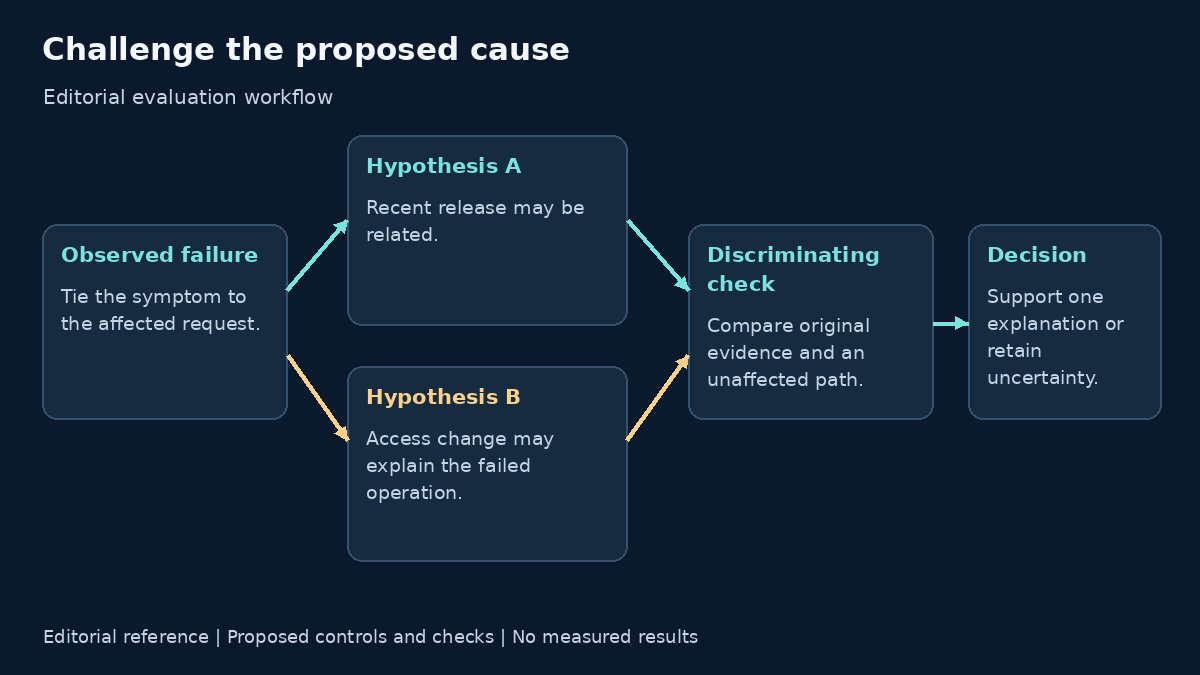
A recent change is a useful lead, but it may be unrelated to the affected request. Ask the tool to identify evidence that would weaken its proposed cause. Compare affected and unaffected paths where possible. The useful output is a testable explanation with known limits, not a confidence score that substitutes for the missing comparison.
4 What happens when the evidence cannot settle the question?
Introduce an ambiguous case deliberately. The product should distinguish a supported explanation from an unresolved possibility and show the next useful check. Missing causal evidence may require another team or a controlled test. Record whether the system preserves that uncertainty or silently upgrades a suggestion into a confirmed diagnosis as the investigation progresses.
5 Can the organization control access and disclosure?
Inspect who can retrieve source records, view generated summaries and export an investigation. Test the relevant roles using accounts with different permissions. A summary can expose restricted information even when its source link is inaccessible. The evaluation should cover the resulting disclosure, not only whether the application successfully denied a direct query.
6 Does the handoff leave another engineer able to continue?
An escalation should carry the affected service, observed impact, source references, hypotheses considered and unresolved decision. Ask someone outside the demonstration team to continue the case. If that person needs the original presenter to explain every inference, the product has not yet shown a reusable evidence trail for incident investigation.
7 Can you repeat the evaluation and inspect its cost?
Retain the input set, configuration and test conditions. Repeat the same cases after relevant product or prompt changes, then explain differences. Review ingestion, retention, query and operational effort under actual commercial terms. A tool can be technically suitable while requiring collection or review work that the proposed operating model has not budgeted.
| Evaluation step | Evidence to inspect | Decision supported |
|---|---|---|
| Select the incident | Permitted input set and known scope | A comparable test for every candidate |
| Associate records | Resource, execution and incident window | Whether the proposed relationship is justified |
| Challenge the cause | Affected and unaffected paths; alternatives | Which hypothesis warrants another check |
| Bound the response | Authority, target and recovery criteria | Proceed, withhold action or escalate |
Put the checklist through a hypothetical failure
Consider an illustrative report-export service whose requests begin waiting after an application release. A demonstration dataset contains that deployment, storage permission denials and an increasing export queue. The early hypothesis blames the release. The evaluation question is whether the tool can establish which requests encountered which failure, rather than selecting whichever event happened nearest the alert.
First, locate an affected export and its execution references. Then inspect the storage operation and the identity used for it. Compare an unaffected export using another permitted identity. If the failing operation predates the queue buildup and the difference matches an access change, the permission hypothesis deserves further testing. The nearby release remains a candidate until the evidence excludes it.
Next, ask what is missing. The records may show denied access without proving why permissions changed. That gap matters to recurrence prevention, even if an authorized policy correction can restore service. A useful investigation separates the immediate failure mechanism, the recovery decision and the later explanation of how the configuration reached that state.
Finally, require a bounded recovery test approved by the responsible owner. Preserve the original evidence, confirm the intended permission change and inspect a representative export afterward. Do not treat a cleared queue alert alone as proof that the report was produced correctly. This scenario is a proposed evaluation exercise, not a reported ClairAI deployment or customer outcome.
Use an evidence scorecard instead of an unqualified ranking
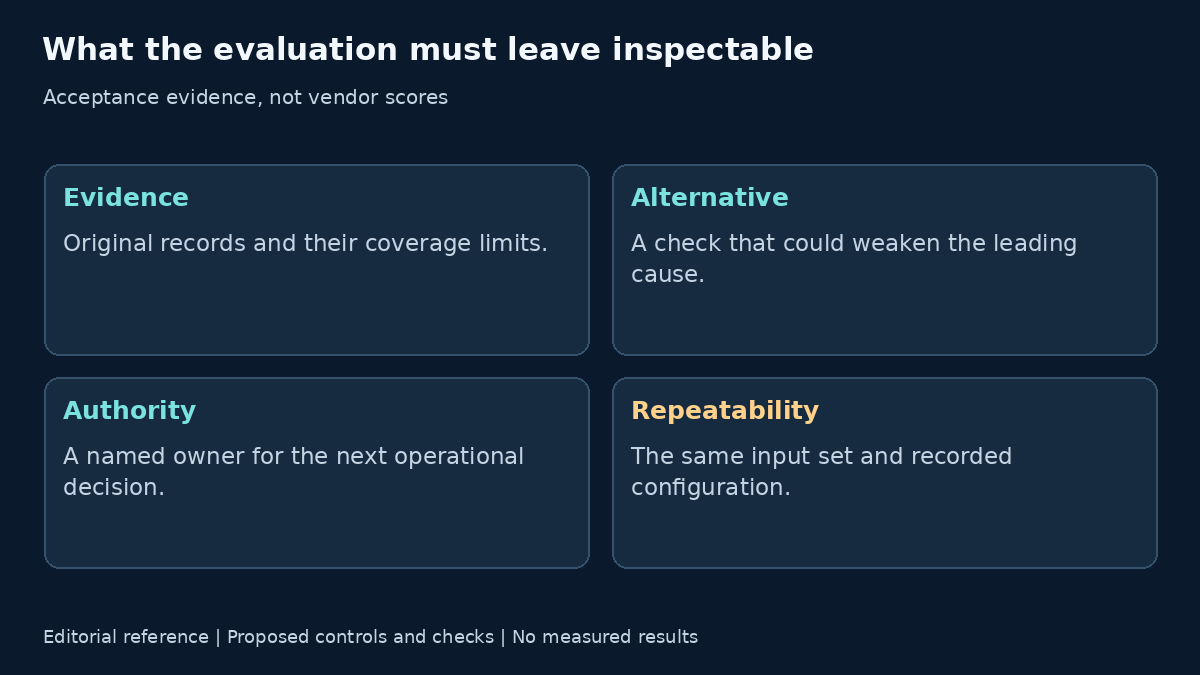
Apply the same seven criteria to every candidate. Record each result as not tested, demonstrated, partially demonstrated or not demonstrated, with an evidence reference. These are review states, not numerical claims about product quality. A feature asserted in a sales discussion belongs in the not-tested category until the agreed exercise establishes its behavior.
Treat mandatory requirements as gates. A candidate that cannot respect the required data access boundary should not compensate with an attractive average score elsewhere. Differentiate an absent capability from a configuration problem or an incomplete test. Assign an owner and a next action to each unresolved requirement so the shortlist reflects evidence rather than presentation quality.
| Criterion | Required demonstration | Review state |
|---|---|---|
| Source coverage | Inspect required fields and a collection gap | Not tested |
| Traceability | Open the evidence behind a material claim | Not tested |
| Hypothesis testing | Challenge the leading cause with contrary evidence | Not tested |
| Uncertainty | Retain missing evidence and a next check | Not tested |
| Access boundaries | Test source and summary visibility by role | Not tested |
| Handoff | Another engineer continues without coaching | Not tested |
| Repeatability and cost | Repeat the input set; record commercial scope | Not tested |
Know what the evaluation cannot establish
A finite test set cannot prove correctness across every future failure. Sampled telemetry can omit the decisive operation. Dependency views may be incomplete or outdated. A convincing explanation can still rest on an incorrect association. State those limitations in the purchase record and define when the system must return control to an engineer.
Escalate before remediation when impact is uncertain, access is insufficient, evidence conflicts or the proposed action exceeds the responder's authority. Include the question the next owner must resolve. The ClairAI article on intelligent alerting provides related signal-prioritization context; this evaluation focuses on whether a proposed cause can withstand inspection after that initial alert.
Separate published capability from deployment proof
OpenTelemetry explains a telemetry-linking mechanism; the scorecard defines buyer acceptance tests. Neither certifies a diagnosis or a product. ClairAI's public site describes conversational RCA and distributed dependency context. Ask for the exact evidence path, supported sources and review controls in the proposed deployment before treating those descriptions as proof of a particular workflow.
Choose a tool your engineers can question
Keep procurement evidence separate from the trial narrative
Ask suppliers to record which evaluated behavior is included in the proposed edition and which requires another component or service. Match the demonstrated configuration to the commercial proposal. A successful exercise using optional access or a different retention setting may not represent the system the organization is actually buying. Resolve that difference before accepting the test result as a purchasing requirement satisfied.
Include an exit question in the evaluation. Determine whether the team can retain its incident references and decision history if it later changes tools, subject to the agreement and applicable data rules. Investigation records often become inputs to runbooks and post-incident review. Losing their context can make previously accepted decisions difficult to reconstruct even when the underlying operational data remains elsewhere.
After shortlisting, run a bounded trial with the engineers who will use the product. Track disagreements between generated explanations and reviewed conclusions, including cases where the tool correctly withheld an answer. Define how those observations affect acceptance. This produces a more useful purchase record than asking participants whether the demonstration felt convincing or whether the interface appeared easier than their current dashboard.
The strongest evaluation leaves an engineer able to explain the evidence, identify what is still uncertain and defend the next operational decision. Keep the same incident set and gates across the shortlist. A plausible answer earns attention; a repeatable, inspectable investigation earns consideration for production use.
Get the RCA evaluation checklist and bring one permitted incident to a ClairAI discussion. Use the seven-question scorecard to define the evidence and access requirements your team needs demonstrated before selection.
Frequently asked questions
Is alert grouping the same as root cause analysis?
No. Grouping organizes signals. RCA must explain a failure mechanism using relevant evidence and identify where the explanation remains uncertain.
What should an RCA tool show besides a confidence score?
Source references, the affected scope, associations used, alternative explanations and the next discriminating check. A score does not replace those records.
How can buyers test missing telemetry?
Remove a relevant record from a permitted evaluation case. Inspect whether the product reports the gap and limits its conclusion rather than asserting an unsupported cause.
What evidence is needed before remediation?
A bounded impact assessment, a supported failure explanation, the proposed action and its authority, and explicit recovery checks. Material uncertainties must remain visible to the approver.
When should the investigation be escalated?
When permissions, conflicting evidence, unknown impact or action consequences prevent a justified decision. Transfer the evidence and the unresolved question to a named owner.
See ClairAI in action
Turn enterprise data chaos into confident, real-time decisions.
Schedule a Demo →