
Data Observability vs Pipeline Reliability: A Buyer Guide
A data pipeline can have excellent monitoring and still fail the business. Its dashboards may report job completion, while downstream analysts receive yesterday’s numbers. Conversely, a dependable pipeline may operate with relatively modest instrumentation because the team has clear delivery commitments, recovery procedures, and ownership. These are not contradictory outcomes: data observability and pipeline reliability answer different questions.
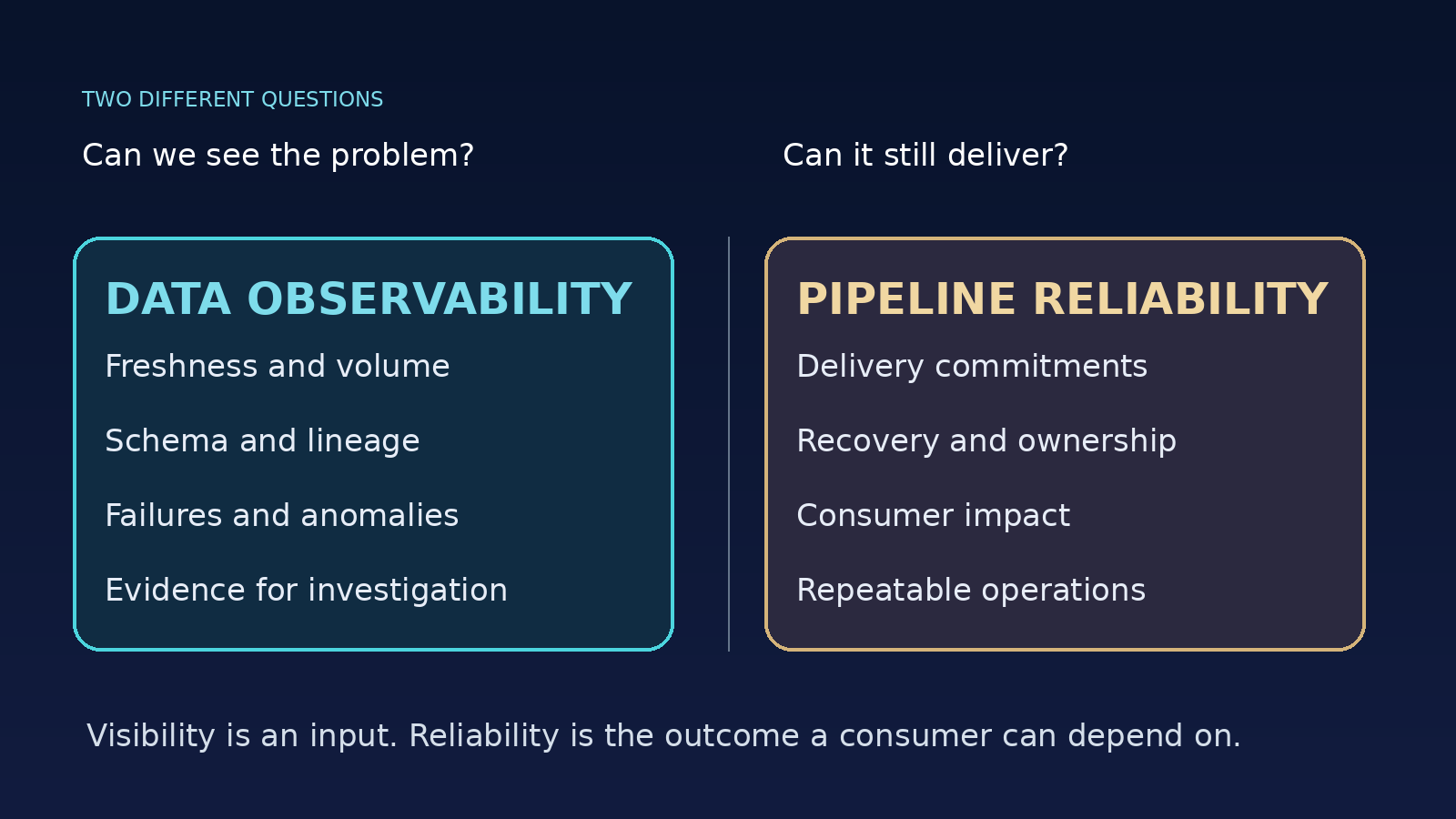
For engineering leaders evaluating platforms, the distinction matters. Observability provides evidence about what is happening inside a data system. Reliability concerns whether that system consistently delivers usable data to its consumers within agreed expectations. Buying one does not automatically establish the other.
What data observability actually covers
Data observability describes the ability to assess the health and behavior of data assets and movement across a system. Common signals include freshness, volume, schema changes, distribution anomalies, job failures, lineage, and the relationships between upstream and downstream assets. The signals help an engineer narrow the investigation when a table arrives late or a transformation produces unexpected output.
A useful observability implementation is not merely a collection of alerts. It connects symptoms to evidence: which dataset changed, when the change began, which upstream operation produced it, what downstream consumers might be affected, and whether the signal is trustworthy. Without that context, alerts can become another queue that engineers must manually interpret.
Consider a daily finance dataset. The ingestion job succeeds at 02:00, but the table’s newest business date is two days old. A job-success metric alone misses the issue; a freshness check exposes it. Lineage then helps identify whether the source extract, transformation, or publication step is responsible. Observability has identified the problem, but the finance team still needs a timely, correct dataset.
What pipeline reliability means to the business
Pipeline reliability is the degree to which a data delivery process meets its commitments under ordinary operation and foreseeable failure. Those commitments must be stated in consumer terms: availability of the right dataset, acceptable freshness, completeness, correctness, and a documented recovery path when delivery slips. Reliability also depends on people and processes: accountable owners, incident thresholds, change controls, and tested restoration procedures.
A reliability target should be specific enough to be tested. “The pipeline should run successfully” says little about the customer outcome. “The curated sales table is ready by 07:00 Eastern on business days, with the prior-day transactions reconciled” gives a consumer and an engineering team a shared acceptance criterion. The commitment may require more than a green scheduler status.
Reliability is therefore not a dashboard category or a vendor feature. It is an operating result, supported by technical controls and evidence. A platform can help teams achieve that result, but the organization must decide what good delivery means and how to respond when it is missed.
Data observability vs pipeline reliability: the buying distinction
| Dimension | Data observability | Pipeline reliability |
|---|---|---|
| Primary question | What changed, where, and why? | Did consumers receive usable data as promised? |
| Typical evidence | Freshness, lineage, schema, volume, logs | SLO attainment, delivery lag, incident recovery |
| Failure focus | Detection and investigation | Prevention, containment, restoration |
| Owner | Data platform / engineering investigators | Service owner with consumer accountability |
| Success test | Actionable, correctly scoped findings | Repeated fulfillment of delivery commitments |
These dimensions overlap but are not interchangeable. A freshness alert can support a reliability objective, while a missed delivery objective can trigger an observability investigation. The purchase decision should identify which gap is currently costing the organization time or trust.
A practical example: when every job is green but the report is wrong
Imagine a retailer whose inventory report is produced by a source extract, an ingestion step, a transformation, and a warehouse publication task. Each scheduled task reports success. However, one regional source sends a partial extract after a network interruption. The transformation accepts the smaller input, and the warehouse publishes a report that understates inventory.
Observability should surface the unusual row-count change, compare freshness across source partitions, and trace the affected report back to the partial extract. Reliability controls should define what happens next: block publication if completeness falls below the accepted threshold, route the exception to an owner, preserve the last trusted version when appropriate, and notify consumers of the delivery status.
The distinction becomes especially important during recovery. Detecting the anomaly at 06:40 is valuable, but it does not prove that the 07:00 report can be delivered. Teams must also know whether replay is safe, whether downstream tables require correction, and who approves release after the repair.
Five evaluation questions for enterprise buyers
1. What consumer commitment are we protecting?
Start with a critical data product and write down who uses it, when it must be ready, and what makes it fit for use. This prevents the evaluation from becoming a feature comparison disconnected from business impact. Ask vendors to demonstrate a late-but-successful pipeline, not just a failed task.
2. Can the platform connect signals to the affected data path?
Inspect the evidence behind each finding. Can an investigator move from an alert to relevant runs, upstream changes, dependent datasets, and a timeline? Ask what happens when lineage is incomplete or data arrives from an unsupported source. A confident diagnosis without sufficient evidence is a risk, not a benefit.
3. How are alert thresholds and incident ownership handled?
A signal matters when the right person can act on it. Evaluate routing by severity, service, data asset, and time window. Determine whether duplicate alerts can be grouped without hiding separate incidents. Confirm how acknowledgments, handovers, and escalation are recorded.
4. What can be repaired safely, and what still needs approval?
Some responses are low risk, such as gathering diagnostic context or retrying an idempotent read. Others, such as overwriting a published table or replaying a non-idempotent write, require explicit controls. Ask vendors to show a failure that must stop at a human approval gate and preserve a record of the decision.
5. Can the organization measure improvement after adoption?
Establish a baseline for missed delivery commitments, time to identify the affected component, time to restore a trusted output, and repeat incidents. Do not substitute alert counts for reliability outcomes. A system that generates more findings may be more sensitive without making the service more dependable.
Where AI-assisted investigation fits
AI-assisted root cause analysis can help organize event timelines, correlate signals, and propose explanations for investigation. In distributed data systems, this can reduce the manual effort of moving between logs, job histories, and platform dashboards. The important word is “propose.” A correlation is not automatically a verified cause, and an explanation should retain the evidence and uncertainty that support it.
For a product such as ClairAI, a buyer conversation should focus on the actual data sources available, the scope of supported investigations, and how findings reach engineers. Do not assume a particular integration, autonomous remediation capability, or guaranteed reduction in incident duration without a product demonstration and supporting evidence. Our guides on data pipeline monitoring, data pipeline observability, and incident investigation explore these operational boundaries in depth.
A phased adoption plan
First, select one data flow with a real consumer and a recurring operational problem. Document its delivery contract and the current investigation process. Second, instrument the points where a successful job could still produce unusable data: freshness, completeness, schema, and publication checks. Third, establish incident ownership and a tested response for each high-impact failure class.
Fourth, rehearse a partial-source arrival, a schema change, and a late upstream dependency. Record whether the team detects the issue, identifies its scope, protects consumers, and restores a trusted output. Finally, review the resulting measures with both platform engineers and business owners. Expand only after the initial flow demonstrates a repeatable operating model.
Common procurement mistakes
The first mistake is buying for alert volume rather than actionable evidence. A large alert inventory can increase noise if the system cannot connect observations to an owner and an affected consumer. The second is treating lineage coverage as universal. Coverage often varies by platform, transformation style, and integration method; buyers should verify it against their own architecture.
The third mistake is assuming reliability can be purchased as a software license. Ownership, delivery contracts, release controls, and recovery rehearsals still need to exist. The fourth is evaluating only the happy path. An enterprise proof of concept should include incomplete inputs, conflicting signals, delayed jobs, and a recovery that cannot be executed without approval.
Conclusion: buy visibility for a reliability objective
Data observability and pipeline reliability belong in the same operating conversation, but they are not synonyms. Observability helps teams see and investigate changes in data systems. Reliability asks whether consumers receive dependable outputs and whether failures are handled predictably. The most useful buying process starts with the latter, then determines what evidence, controls, and workflows are needed to achieve it.
If your team is evaluating AI-assisted investigation for complex data and platform incidents, evaluate AI-assisted incident investigation with ClairAI and request a demonstration using a representative failure scenario. Ask to see the evidence trail, investigation boundaries, and handoff to the responsible engineer.
Frequently asked questions
Is data observability the same as data quality?
No. Data quality describes properties such as validity, completeness, and consistency. Observability monitors signals and relationships that can reveal quality issues and support their investigation.
Can a pipeline be reliable without an observability platform?
Yes, particularly in a smaller or simpler environment with clear checks and strong operational practices. As dependencies grow, broader visibility can make failures easier to detect and investigate.
Which metrics matter most for pipeline reliability?
Use consumer-oriented measures such as on-time delivery, freshness against an agreed threshold, completeness, successful recovery, and the number of missed delivery commitments.
Does AI root cause analysis replace incident owners?
No. AI-generated hypotheses still need evidence, validation, and accountable decisions, especially when a proposed action can change production data.
What should a proof of concept include?
Include at least one late-successful run, one incomplete source delivery, one schema change, and one recovery requiring human approval. Evaluate evidence quality and consumer impact, not just alert generation.
See ClairAI in action
Turn enterprise data chaos into confident, real-time decisions.
Schedule a Demo →